
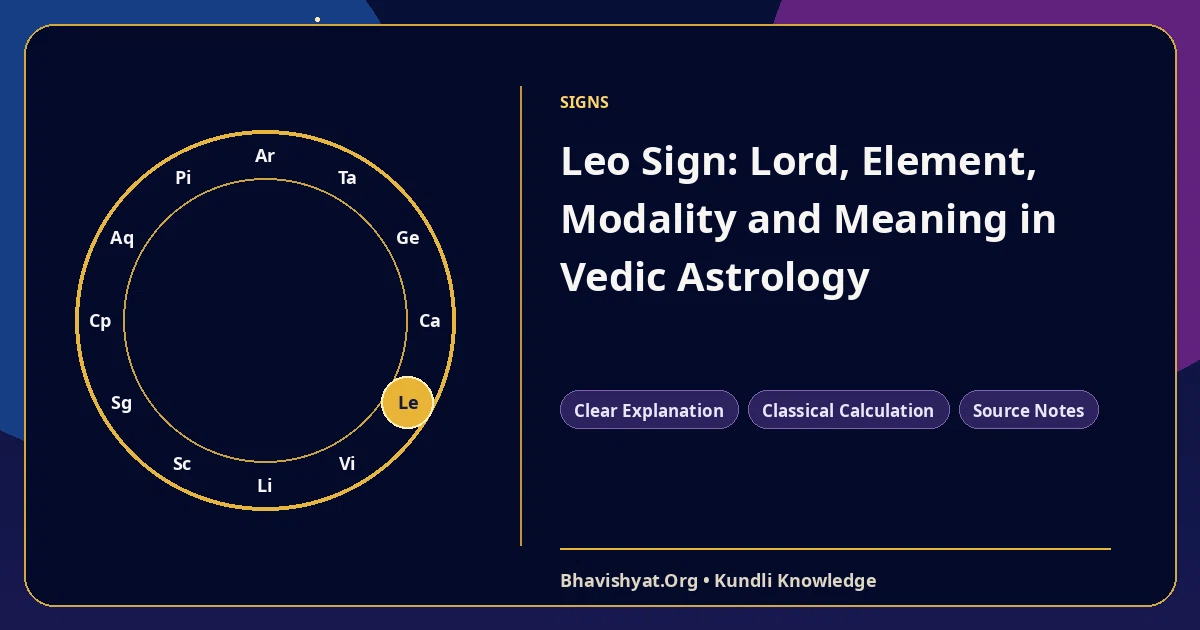
Leo Sign: Lord, Element, Modality and Meaning in Vedic Astrology
Leo is the 5th zodiac sign. It is ruled by Sun, belongs to the fire element and has a fixed modality. Its general style includes expression, leadership, pride, creative centre, status and self-radiance. In a birth chart, however, a sign is never judged only from a personality description. The astrologer identifies which it occupies, evaluates its , examines planets placed there and judges how comfortably those planets operate in the sign.
Foundational nature of Leo
Leo combines the fire element with a fixed mode. Element describes the medium through which energy tends to operate, while modality shows whether that energy initiates, stabilises or adapts. In Leo, expression, leadership, pride, creative centre, status and self-radiance are useful descriptors, but they are not a complete personality verdict. Vedic natal analysis requires the ascendant, Moon, house lords and the whole chart rather than a Sun-sign style profile.
The traditional ruler is Sun. Its condition becomes central to the practical functioning of Leo in a chart. If Sun is strong and well connected, the matters carried through this sign may be expressed more coherently. If the sign lord is weak, combust, heavily afflicted or inactive by timing, planets placed in Leo may receive less support from their .
Sign and house are different layers
Leo is a zodiacal style, while a house is a life field. If Leo occupies the first house, its qualities shape identity and physical expression; if it occupies the tenth, the same qualities become more visible through profession and public responsibility. A statement about Leo is therefore incomplete without identifying its house position.
House numbers must not be permanently equated with sign numbers. Leo is sign number 5, but it does not occupy house 5 in every chart. The actual ascendant determines where it falls. This is one of the major differences between a generic zodiac description and an individual Vedic birth chart.
Sun as the ruler of Leo
Sun acts as the administrative planet for this sign. Even a strong-looking occupant partly depends on the condition of Sun. This is the dispositor principle. Judge where Sun is placed, the houses it owns, sign dignity, conjunctions, aspects, Shadbala and whether its dasha is active.
A strong sign lord does not automatically guarantee a favourable outcome. Functional lordship may combine constructive and difficult agendas. The correct conclusion states what the planet has capacity to do and whether that capacity is likely to support or pressure the specific life field.
How planets behave in Leo
Every planet expresses its natural agenda through the fire, fixed pattern of Leo. The Sun brings identity and authority, Moon emotional processing, Mars action, Mercury analysis and communication, Jupiter expansion, Venus harmony, Saturn structure, Rahu amplification and Ketu detachment. Friendship, exaltation or debilitation, nakshatra, house placement and functional lordship significantly modify those broad themes.
Separate sign dignity from house outcome. A planet can be dignified yet functionally rule difficult houses, while a debilitated planet can be modified by cancellation, supportive aspects, varga strength or other components of strength. This distinction prevents stereotyped sign interpretations.
Nakshatra and degree refinement
Different nakshatra padas fall within Leo. A planet at an early degree and another near the end of the sign may have different nakshatra lords, Navamsha positions and degree-based activations. The sign is therefore only one layer. Nakshatra and pada refine the operating channel, particularly for Rahu and Ketu where sign lord and nakshatra lord are both important.
Degrees also affect conjunction intensity, combustion near the Sun, relevance of planetary war and some angular aspect calculations. Two planets in the same sign but separated widely are not interpreted exactly like a tight conjunction.
Measuring the strength of the sign lord
Examine Sun through , positional strength, where applicable, aspectual support and varga dignity. The of the house occupied by Leo is a separate measure. A strong ruler with a weak house can indicate good administrative capacity under structural pressure; the opposite pattern can indicate opportunity with weaker execution.
can help compare aggregate support for the sign or house, while the relevant planet’s can refine transit response. Ashtakavarga is a numerical support layer and should not be confused with sign personality.
Divisional charts and timing
The D1 indication involving Leo can be checked in a relevant varga. D9 refines underlying planetary dignity, D10 profession, D7 children, D4 property and D24 education. If Leo governs an important natal house, judge its lord and significator again in the appropriate divisional chart.
A of Sun, an occupant of Leo, or a connected house lord can activate its agenda. A then functions as a trigger. A current planet merely moving through Leo is not enough to promise the same event for everyone; natal promise and timing are essential.
A ten-point method for reading Leo
- Establish which natal house is occupied by Leo.
- Combine that house agenda with the fire element and fixed modality.
- Locate Sun and determine all houses it owns.
- Judge Sun for dignity, Shadbala, conjunctions and aspects.
- Assess every planet occupying Leo through natural and functional roles.
- Add nakshatra lord and degree proximity for conjunctions and combustion.
- Keep Bhavabala and planetary strength separate when they disagree.
- Use SAV/BAV as comparative support.
- Confirm the subject in the relevant divisional chart.
- Strengthen event timing only when dasha and transit converge.
A simple example
Suppose Leo occupies the tenth house and Sun is strong with a connection to the eleventh. Career may express some of the sign’s themes—expression, leadership, pride, creative centre, status and self-radiance—and become linked to networks or gains. If the tenth house is heavily pressured or D10 weakens the tenth lord, professional struggle or restructuring can coexist with that capacity.
In another chart, Leo may occupy the fourth house while Sun is placed in the twelfth, linking home or residence with foreign places, relocation, seclusion or higher expenditure. This is only an illustration; actual judgement must combine the ruler, significators, Bhavabala, D4 and timing.
For deeper study, also read What Is a Sign Lord? Planetary Rulers of the 12 Rashis and Their Use, Aries Sign: Lord, Element, Modality and Meaning in Vedic Astrology, Taurus Sign: Lord, Element, Modality and Meaning in Vedic Astrology, Gemini Sign: Lord, Element, Modality and Meaning in Vedic Astrology, Cancer Sign: Lord, Element, Modality and Meaning in Vedic Astrology and Virgo Sign: Lord, Element, Modality and Meaning in Vedic Astrology.
Read Astrological Calculations
Calculation sequence: identify the house occupied by Leo → locate Sun and its lordships → assess dignity of planets in the sign → add nakshatra/pada → measure house and planetary strength → confirm through relevant varga → activate through dasha and transit.
Leo is a fire, fixed sign ruled by Sun. These describe operating style, not the final direction of results; house lordship and the complete chart determine outcome.
The opposite sign is Aquarius; the 1–7 polarity can sometimes illuminate balance themes, but it should not be turned into a standalone compatibility rule.
Classical references and textual note
The purpose here is not to turn one verse into a mechanical prediction, but to explain the classical decision process in accessible language.
तत्तद्भावात्कारकादेवमूह्यं तत्तन्मातृभ्रातृपित्रात्मजाद्यम् । तस्मिन् भावे कारके भावनाथे वीर्योपेते तस्य भावस्य सौखम् ॥
- Brihat Parashara Hora Shastra — for the Parashari framework of signs, planets, houses, aspects, strength and timing.
- Phaladeepika, Chapter 15 — for the principle of judging a house together with its lord, significator and strength.
- In the traditional seven-planet rulership framework, Leo is ruled by Sun.
Printed editions may contain minor textual variants. For calculation work, keep the source edition, ayanamsha and software settings consistent.
How should this principle be applied to your own chart?
A general article explains the rule, but its expression in your birth chart depends on the ascendant, house lords, planetary strength, aspects, dasha, transit and relevant divisional charts. A personal analysis is required to establish whether this principle is actually strong, weak, modified or currently activated in your chart.
भावेश, ग्रहबल, दृष्टि, दशा, गोचर और संबंधित वर्ग कुंडलियों के संयुक्त परीक्षण के बिना व्यक्तिगत निष्कर्ष लॉक नहीं किया जाता।Personal judgement is not locked without jointly testing lordship, strength, aspects, dasha, transit and relevant divisional charts.
अपनी कुंडली का विश्लेषण करवाएँGet Your Kundli Analysedसंबंधित अध्ययनContinue Learning
 What Is a Sign Lord? Planetary Rulers of the 12 Rashis and Their Use
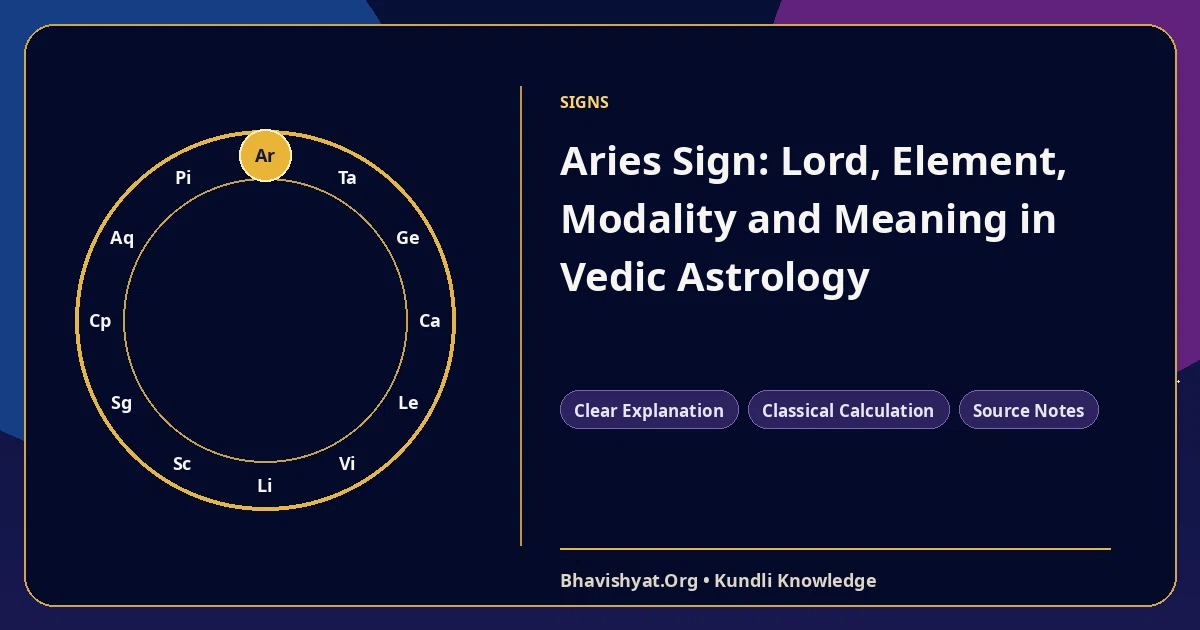 Aries Sign: Lord, Element, Modality and Meaning in Vedic Astrology
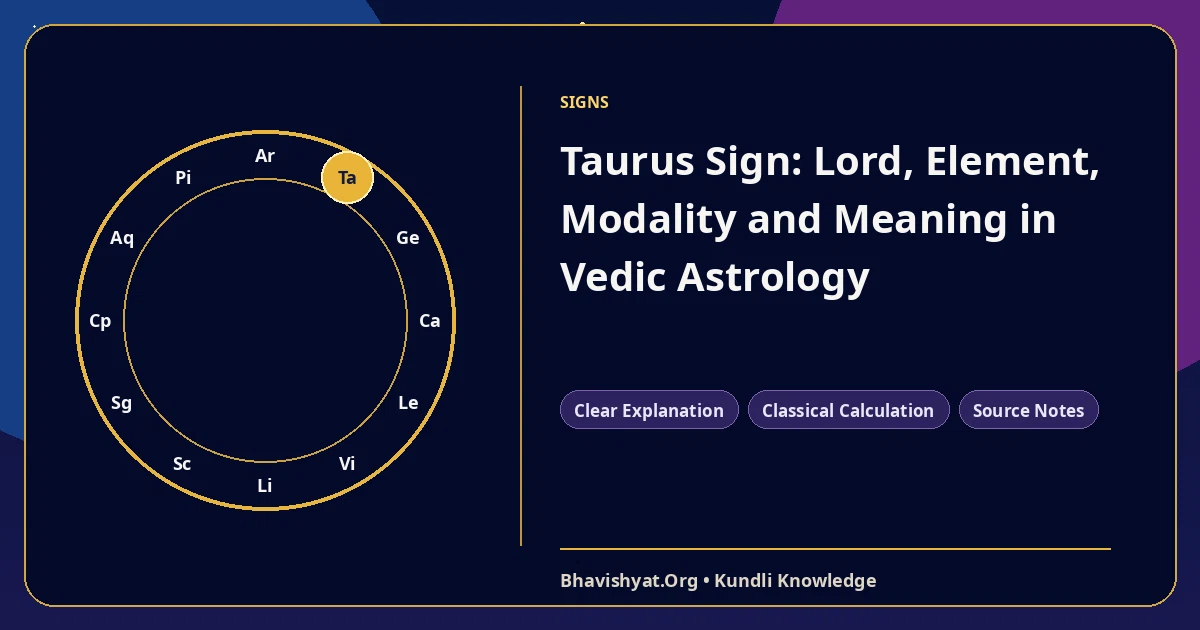 Taurus Sign: Lord, Element, Modality and Meaning in Vedic Astrology
 Gemini Sign: Lord, Element, Modality and Meaning in Vedic Astrology
 Cancer Sign: Lord, Element, Modality and Meaning in Vedic Astrology
 Virgo Sign: Lord, Element, Modality and Meaning in Vedic Astrology