
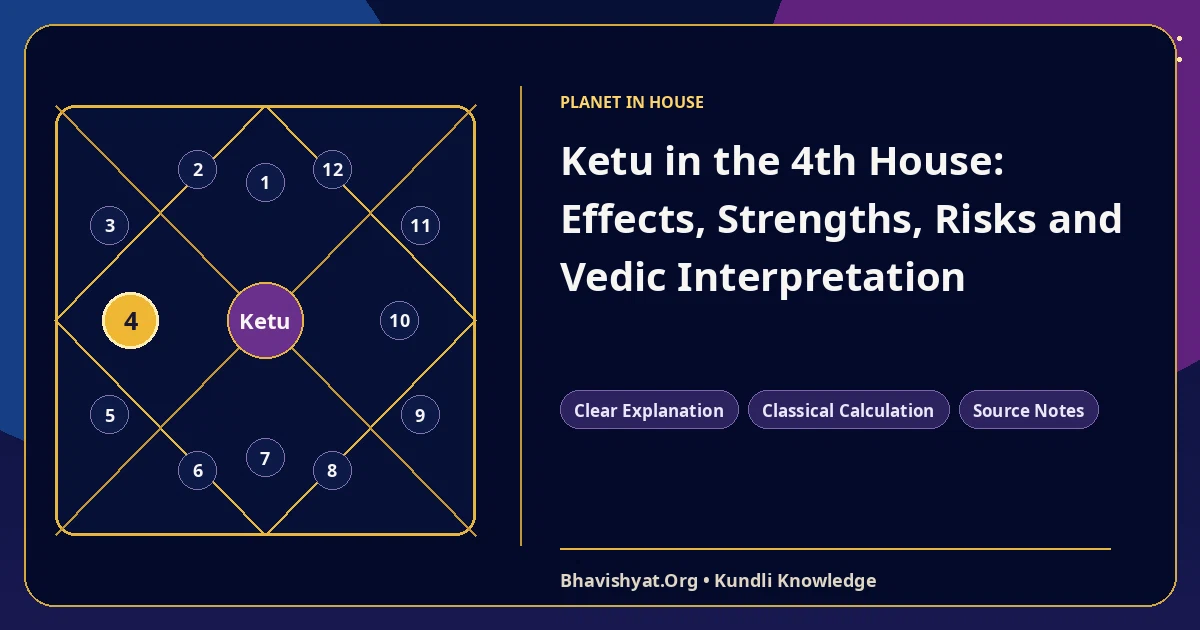
Ketu in the 4th House: Effects, Strengths, Risks and Vedic Interpretation
Ketu in the 4th House connects the planetary agenda of detachment, separation, inward inquiry, sharp insight, discontinuity, inherited skill and subtle spiritual tendencies with the life field of mother, home, property, vehicles, domestic comfort, inner peace, foundational education and emotional grounding. It does not mean that Ketu is always good or always difficult in this house. The final result depends on which houses Ketu functionally rules, its sign and nakshatra, the strength of its , the of the 4th House, aspects and conjunctions, and the active and .
Core interaction: Ketu and the 4th House
Ketu naturally signifies detachment, separation, inward inquiry, sharp insight, discontinuity, inherited skill and subtle spiritual tendencies, while the 4th House governs mother, home, property, vehicles, domestic comfort, inner peace, foundational education and emotional grounding. Their interaction requires the planet to express itself through building the foundation of home, mother, property and inner peace. In a supported condition, subtle insight, analytical separation, detachment, research, spiritual concentration and instinctive use of old skill can organise the house agenda. Under pressure, disconnection, indifference, sudden distancing, lack of satisfaction or disengagement from material concerns may become more visible in the same life field.
This placement also operates within the house classification of a kendra house. An upachaya frames development through effort, a dusthana can emphasise problem-solving or transformation, and a kendra or trikona can increase visibility, foundation or support. House classification does not override functional lordship.
Natural planetary agenda and house agenda
When the natural significations of Ketu—detachment, separation, inward inquiry, sharp insight, discontinuity, inherited skill and subtle spiritual tendencies—meet the 4th House themes of mother, home, property, vehicles, domestic comfort, inner peace, foundational education and emotional grounding, a composite result is formed. If the planetary operating style fits the needs of the house, expression can become direct and productive. When the two are in tension, growth may come through adjustment, conflict, training or maturity.
Natural indicators for the house include the Moon signifies mother and emotional comfort; Venus relates to vehicles and amenities, and Mercury contributes to education. These should be checked alongside Ketu. A strong occupant with a weak natural significator can show capacity without equivalent stability or satisfaction, whereas both layers supporting each other produce a more coherent promise.
Functional lordship changes the result
The same Ketu owns different houses for different ascendants. Before interpreting this placement, write down its functional lordships. A trinal lord, kendra lord, gain lord, dusthana lord or maraka role carries a different agenda into the 4th House. This is one reason two people with the same planet-house placement can live very different outcomes.
The houses owned by Ketu become source houses and the 4th House becomes the destination of that agenda. Wealth, marriage, profession, education or foreign themes may therefore connect with mother, home, property, vehicles, domestic comfort, inner peace, foundational education and emotional grounding. Whether the connection helps or pressures the native depends on strength, sign condition and relationships.
Sign, dignity and dispositor
Traditional rulership of Ketu: no universally accepted fixed sign ownership across classical traditions; exaltation context: exaltation and debilitation are tradition-dependent; debilitation context: tradition-dependent. The actual sign in the 4th House depends on the ascendant, and that sign determines dignity and the dispositor.
If Ketu is dignified and supported by a capable dispositor, subtle insight, analytical separation, detachment, research, spiritual concentration and instinctive use of old skill may be easier to channel into building the foundation of home, mother, property and inner peace. If it is debilitated, combust, afflicted or dependent on a weak dispositor, disconnection, indifference, sudden distancing, lack of satisfaction or disengagement from material concerns may become more pronounced. Cancellation, supportive aspects, varga dignity and other strength components can significantly modify the picture.
Aspects and conjunctions
Aspect pattern: special aspects are school-dependent and the chosen tradition should be stated. From the 4th House, the houses reached by Ketu create secondary channels through which this placement operates. Those receiving houses may link profession, relationships, gains, dharma or other themes to the primary house.
Ketu should be read through its sign lord, nakshatra lord, conjunctions and the complete Rahu-Ketu axis. Jupiter can add guidance or protection, Saturn discipline or delay, Mars sharpness, Venus harmony, and the Rahu-Ketu axis unusual intensity. Degree closeness in conjunctions matters; sharing a sign is not always equivalent to a tight conjunction.
Planetary strength: Shadbala and Dig Bala
Ketu is a shadow graha, so the classical seven-planet and framework should not be mechanically applied. In this placement, use sign lord, nakshatra lord, conjunctions, the opposite node, Bhavabala and dasha as primary strength evidence.
If software supplies a proprietary strength score for the nodes, label it as such rather than calling it classical Shadbala. For Ketu, the dispositor chain, nakshatra lord and axis often provide the clearest diagnostic context.
Bhavabala: can the house support the placement?
The of the 4th House is different from the strength of Ketu. A strong planet can work hard inside a weak structural field; a strong house with a weak occupant can offer opportunity without equal execution. When house and planet are both supported, the native has a stronger platform for building the foundation of home, mother, property and inner peace.
Also judge the actual lord of the 4th House. Ketu is the occupant, but another planet may own the house. The house lord’s condition determines sustainability and administration of the field. Occupant-only interpretation is therefore incomplete.
BAV and SAV support
can still be used as an aggregate support layer for the house. Including Rahu or Ketu in a classical-style BAV is not a universally accepted traditional rule; any modern node extension should be explicitly identified as a separate method.
A high BAV/SAV value does not erase natal weakness, and a low value does not cancel a strong natal promise. The system is best used for comparative support and transit refinement.
D9 and subject-specific vargas
Check the D1 placement of Ketu against D9 for underlying dignity. If the question concerns a specific part of mother, home, property, vehicles, domestic comfort, inner peace, foundational education and emotional grounding, add the relevant varga: D2 wealth, D4 property, D7 children, D10 profession, D20 spiritual practice or D24 education. Not every varga belongs in every question.
When D1 and the relevant varga both support Ketu, consistency increases. A strong D1 with a weak domain-specific varga may show opportunity with uneven execution. A favourable varga should not manufacture a large promise that D1 does not contain.
How Ketu in house 4 activates in dasha
Mahadasha or Antardasha of Ketu can directly activate the placement. Periods of the 4th House lord, natural significators such as the Moon signifies mother and emotional comfort; Venus relates to vehicles and amenities, and Mercury contributes to education, or closely connected planets can also bring the subject into focus. The magnitude depends on the natal promise and overlapping periods.
Transit becomes more meaningful when Ketu, the house lord, slow-moving triggers or the node axis activate a sensitive natal degree while the same subject is open in dasha. This convergence model is more reliable than a fixed calendar prediction based on transit alone.
Constructive expressions
If Ketu is strong, functionally supportive, governed by a capable dispositor and receives constructive support in the 4th House, subtle insight, analytical separation, detachment, research, spiritual concentration and instinctive use of old skill can become useful in the house agenda. The native may develop greater agency, clarity or specialised capacity in building the foundation of home, mother, property and inner peace.
When the natural agenda of Ketu and the house requirement fit well, the life field can become a visible area of competence. Where they pull in different directions, the same placement may force development of new skill, adjustment or discipline before results become stable.
Potential challenges
If Ketu is weak, afflicted, functionally difficult or dependent on a poor dispositor, disconnection, indifference, sudden distancing, lack of satisfaction or disengagement from material concerns may appear through mother, home, property, vehicles, domestic comfort, inner peace, foundational education and emotional grounding. The exact challenge depends on sign and aspect pattern: delay, volatility, conflict, detachment or over-expansion are different mechanisms and should not be collapsed into one negative label.
A challenge is not automatically denial. Upachayas may build skill through time, dusthanas can build problem-solving capacity, kendras can convert pressure into responsibility, and trikonas can reshape values or judgement. A useful interpretation identifies both the difficulty and the mechanism through which it can be managed.
Worked judgement example
Suppose Ketu occupies the 4th House in a friendly sign, has adequate strength, the house lord is also capable, and the relevant divisional chart confirms the promise. SAV is above average, but the current dasha does not activate the planet or house. The natal capacity may be supportive, yet an immediate event should not be promised. When dasha and transit align, the same capacity can become more visible.
In another chart the same Ketu in the 4th House may depend on a weak dispositor, form a close difficult conjunction and occupy a low-Bhavabala house while the planet itself scores strongly in one component. The planet may be highly noticeable but its experience more demanding. This is why the placement title alone cannot predict a life story.
Twelve-point audit checklist
- Calculate the functional lordship of Ketu from the ascendant.
- Identify the sign in the 4th House and its ruler.
- Assess the dignity of Ketu: own, exalted, debilitated, friendly or hostile sign.
- Judge the dispositor’s house placement, strength and relationships.
- Independently assess the 4th House lord and natural significators: the Moon signifies mother and emotional comfort; Venus relates to vehicles and amenities, and Mercury contributes to education.
- Read conjunctions and aspects with degree proximity.
- For Rahu/Ketu, prioritise dispositor, nakshatra lord and the full node axis.
- Measure Bhavabala separately from occupant strength.
- Use BAV/SAV only as a comparative support layer.
- Confirm through D9 and the subject-specific varga.
- Check Mahadasha-Antardasha activation.
- Increase event-timing confidence only when transit and degree triggers converge.
For deeper study, also read Ketu in the 2nd House: Effects, Strengths, Risks and Vedic Interpretation, Ketu in the 3rd House: Effects, Strengths, Risks and Vedic Interpretation, Ketu in the 5th House: Effects, Strengths, Risks and Vedic Interpretation, Ketu in the 6th House: Effects, Strengths, Risks and Vedic Interpretation, Sun in the 4th House: Effects, Strengths, Risks and Vedic Interpretation and Moon in the 4th House: Effects, Strengths, Risks and Vedic Interpretation.
Read Astrological Calculations
Core calculation: Ketu = detachment, separation, inward inquiry, sharp insight, discontinuity, inherited skill and subtle spiritual tendencies; 4th House = mother, home, property, vehicles, domestic comfort, inner peace, foundational education and emotional grounding; house classification = a kendra house. Add functional lordship and the actual sign to convert this generic placement into a chart-specific judgement.
For Ketu, fixed ownership and exaltation schemes vary by tradition; do not mechanically impose the seven-planet Shadbala framework.
House-strength anchors: the fourth lord, Moon, Venus, Mercury, fourth-house Bhavabala, D4 for property and D24 for education. Final chain: house → house lord → karaka → occupant Ketu → sign/dispositor → aspects → strength → varga → BAV/SAV → dasha → transit.
Classical references and textual note
The purpose here is not to turn one verse into a mechanical prediction, but to explain the classical decision process in accessible language.
तत्तद्भावात्कारकादेवमूह्यं तत्तन्मातृभ्रातृपित्रात्मजाद्यम् । तस्मिन् भावे कारके भावनाथे वीर्योपेते तस्य भावस्य सौखम् ॥
- Brihat Parashara Hora Shastra — for the Parashari framework of signs, planets, houses, aspects, strength and timing.
- Phaladeepika, Chapter 15 — for the principle of judging a house together with its lord, significator and strength.
- Phaladeepika 15.25 emphasises that the relevant house, its karaka and its lord should be assessed together rather than in isolation.
- Planetary strength should be decomposed into positional, directional, temporal, motional, natural and aspectual support rather than reduced to one label.
- Results of Ketu in the 4th House should be judged through the combined house-lord-significator-strength framework rather than from a single aphorism.
Printed editions may contain minor textual variants. For calculation work, keep the source edition, ayanamsha and software settings consistent.
How should this principle be applied to your own chart?
A general article explains the rule, but its expression in your birth chart depends on the ascendant, house lords, planetary strength, aspects, dasha, transit and relevant divisional charts. A personal analysis is required to establish whether this principle is actually strong, weak, modified or currently activated in your chart.
भावेश, ग्रहबल, दृष्टि, दशा, गोचर और संबंधित वर्ग कुंडलियों के संयुक्त परीक्षण के बिना व्यक्तिगत निष्कर्ष लॉक नहीं किया जाता।Personal judgement is not locked without jointly testing lordship, strength, aspects, dasha, transit and relevant divisional charts.
अपनी कुंडली का विश्लेषण करवाएँGet Your Kundli Analysedसंबंधित अध्ययनContinue Learning
 Ketu in the 2nd House: Effects, Strengths, Risks and Vedic Interpretation
 Ketu in the 3rd House: Effects, Strengths, Risks and Vedic Interpretation
 Ketu in the 5th House: Effects, Strengths, Risks and Vedic Interpretation
 Ketu in the 6th House: Effects, Strengths, Risks and Vedic Interpretation
 Sun in the 4th House: Effects, Strengths, Risks and Vedic Interpretation
 Moon in the 4th House: Effects, Strengths, Risks and Vedic Interpretation