
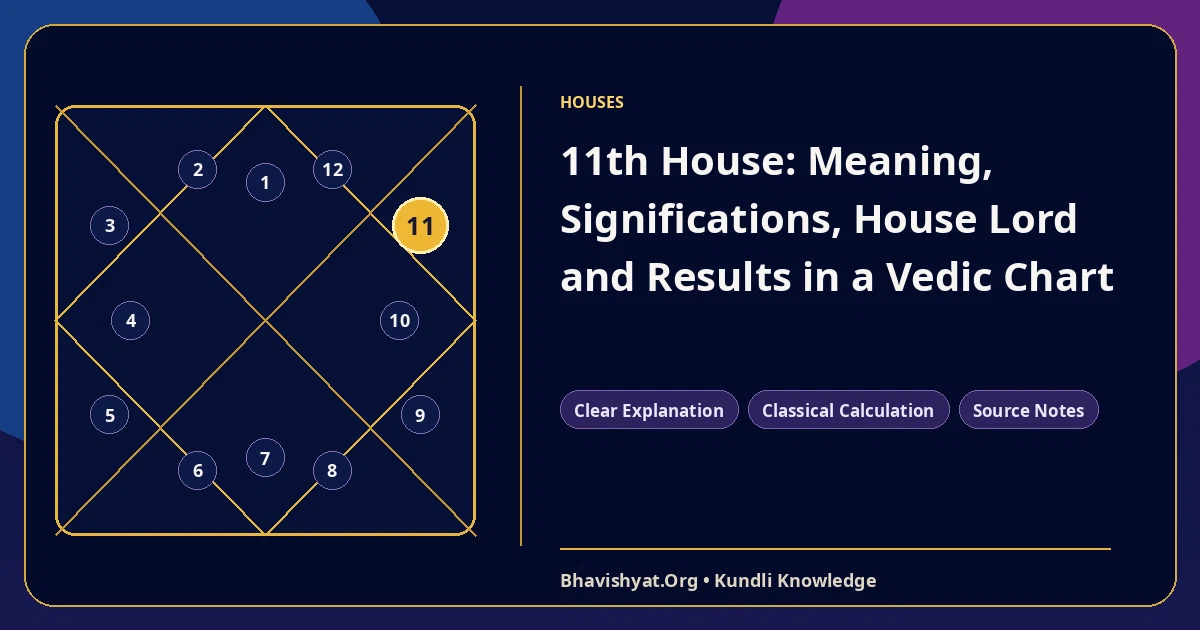
11th House: Meaning, Significations, House Lord and Results in a Vedic Chart
11th House is the field of the birth chart associated with gains, income, networks, major goals, fulfilment, associations, elder siblings and the realisation of objectives. A house should never be read only from the planet occupying it. Sound judgement combines the , its , the natural , sign, aspects, and the active . This article first explains the subject in plain language and then opens the technical layer for readers who want the classical calculation sequence.
Core meaning of the 11th House
The primary field includes gains, income, networks, major goals, fulfilment, associations, elder siblings and the realisation of objectives. It is classified as an upachaya house. A house is not a fixed checklist in which every item activates at the same time. The astrologer isolates the sub-topic asked about and then identifies the natural significator and relevant divisional chart. The same house can therefore become prominent through different manifestations in different periods of life.
Natural indicators include Jupiter is a principal significator for gains and expansion. The significator describes the universal nature of the subject, while the house lord describes the chart-specific mechanism through which the subject operates. If house, lord and significator are all well supported, expression tends to be more coherent. When they disagree, results can become mixed, delayed, conditional or uneven.
House, sign and house lord are different layers
The house is the field of life, the sign describes the style through which that field operates, and the house lord carries the agenda of the field to the house it occupies. Which sign falls in the 11th House depends entirely on the ascendant. It is therefore incorrect to equate house 11 permanently with a zodiac sign.
After locating the house lord, judge its sign dignity, own or exalted status, friendship, debilitation, combustion or retrogression where applicable, conjunctions, aspects and Shadbala. A powerful lord in a pressured house may produce a different experience from a weak lord supported by a strong house. Capacity, environment and timing should be kept conceptually separate.
How to use house significations
All significations of the 11th House do not become equally active together. One period may activate one part of gains, income, networks, major goals, fulfilment, associations, elder siblings and the realisation of objectives, while another period activates a different part. For this reason the statement that a house is simply good or bad is rarely adequate. A useful interpretation names the exact sub-topic, the planet or lord carrying it, and the timing mechanism that activates it.
A practical minimum is a three-part test: the house itself, its lord, and the natural significator. Then examine the eleventh lord, Jupiter, eleventh-house Bhavabala, connections among houses 2/10/11 and dasha activation. Strength of the eleventh can increase opportunity and gain potential, but actual accumulation requires the second house and sustainable earning also depends on the tenth. This illustrates why a single placement should not become the final verdict.
Balancing supportive and difficult influences
A natural benefic aspect may increase protection, coherence or ease, but functional lordship and planetary strength still matter. A natural malefic may bring pressure, effort, competition or discipline; in some contexts, particularly upachaya themes, that pressure can become a mechanism of growth. Benefic and malefic therefore describe planetary operating style, not a guaranteed outcome.
Conjunctions should also be assessed by degree. Two planets in the same sign but far apart may behave differently from a close conjunction. Combustion near the Sun, special aspects of Mars or Saturn, protective influence of Jupiter, and the Rahu-Ketu axis can all change the narrative. For the nodes, dispositor and nakshatra lord deserve particular weight.
Bhavabala, Shadbala and Ashtakavarga
measures structural support for the house, whereas measures the strength of the relevant classical planet. These are not interchangeable. A strong house can have a weak lord, and a strong lord can operate in a structurally pressured house. Such contradictions often explain why opportunity and execution do not always match.
and provide a comparative support layer. SAV helps compare aggregate support to the sign or house, while the BAV of a transiting planet can refine transit judgement. Ashtakavarga should support the natal promise rather than replace it.
Confirmation through divisional charts
Useful confirmation anchors include the eleventh lord, Jupiter, eleventh-house Bhavabala, connections among houses 2/10/11 and dasha activation. A favourable varga cannot manufacture a major promise that is absent from D1. Conversely, when D1 is clear, the relevant divisional chart can show whether the promise is stable, refined, internally strong or more difficult to realise. Accurate birth time becomes increasingly important in finer vargas.
D9 refines underlying planetary strength and dharma or relationship matters; D10 is central for profession, D7 for children, D4 for property and D24 for education. It is unnecessary to add every divisional chart to every question. Use only the varga relevant to the subject so that the evidence remains interpretable.
Activation through dasha and transit
The natal chart shows the basic promise of the 11th House; and refine when that promise becomes active. Periods of the house lord, occupants, aspecting planets or natural significator can bring the field into focus. Transit then acts as a trigger or pressure point on the already existing promise.
Reliable timing looks for convergence among natal promise, dasha activation and transit trigger. A transit without natal or dasha support may produce only a temporary mood or small event. Ashtakavarga support and degree activation can further refine timing.
Practical interpretation checklist
- Identify the sign occupying the 11th House and its planetary lord.
- Locate the house lord and judge sign dignity, conjunctions, aspects and nakshatra context.
- Independently assess the natural significator: Jupiter is a principal significator for gains and expansion.
- Review supportive and restrictive aspects, including degree closeness where relevant.
- Read Bhavabala and the lord’s Shadbala separately rather than substituting one for the other.
- Use the relevant divisional chart for property, children, marriage, education, profession or another specialised question.
- Compare SAV support and, for transit analysis, the relevant planet’s BAV.
- Check whether Mahadasha and Antardasha activate the house, lord or significator.
- Treat transit as a trigger, not as a standalone promise.
- State both supportive and restrictive evidence in the final judgement.
A simple worked example
Suppose the lord of the 11th House is in a friendly sign, has sufficient Shadbala and receives a supportive Jupiter influence, while SAV is only average and the current dasha belongs to an unrelated planet. The natal structure may be sound, but it would be premature to promise an immediate major event. When the lord or significator becomes active and a relevant transit reaches the house or degree, the same latent capacity can become more visible.
Conversely, if the lord is weak but the house contains a strong planet and has good aggregate support, opportunities may appear while continuity or personal control remains uneven. This layered distinction is one of the main differences between a generic horoscope statement and a serious natal chart analysis.
For deeper study, also read The 12 Houses of a Vedic Birth Chart: Meanings, Significations and Life Areas, What Is Bhava Karakatva? What Each House Signifies in Vedic Astrology, Kendra and Trikona Houses: Structural Strength in a Vedic Chart, Upachaya Houses: Houses That Improve Through Effort and Time, Trika Houses 6, 8 and 12: Correctly Understanding Difficult Houses and 1st House: Meaning, Significations, House Lord and Results in a Vedic Chart.
Read Astrological Calculations
Calculation sequence: establish the ascendant → identify the sign in the 11th House → determine its sign lord/house lord → judge the lord’s placement and dignity → measure house and planetary strength → assess the natural significator → add aspects/conjunctions → confirm through relevant varga, BAV/SAV and dasha-transit.
Shadbala separates Sthana, Dig, Kala, Cheshta, Naisargika and Drik Bala. Do not interpret a software total without understanding which components are actually strong or weak.
Primary strength anchors for this house include the eleventh lord, Jupiter, eleventh-house Bhavabala, connections among houses 2/10/11 and dasha activation. Where these anchors contradict each other, keep the verdict mixed and separate natal capacity from event timing.
- Do not mechanically apply the seven-planet Shadbala/Digbala framework to Rahu and Ketu; use dispositor and nakshatra-lord context.
- Use divisional charts to confirm D1, not to replace it.
- Treat Ashtakavarga as comparative support rather than a deterministic guarantee.
Classical references and textual note
The purpose here is not to turn one verse into a mechanical prediction, but to explain the classical decision process in accessible language.
तत्तद्भावात्कारकादेवमूह्यं तत्तन्मातृभ्रातृपित्रात्मजाद्यम् । तस्मिन् भावे कारके भावनाथे वीर्योपेते तस्य भावस्य सौखम् ॥
- Brihat Parashara Hora Shastra — for the Parashari framework of signs, planets, houses, aspects, strength and timing.
- Phaladeepika, Chapter 15 — for the principle of judging a house together with its lord, significator and strength.
- Phaladeepika 15.25 emphasises that the relevant house, its karaka and its lord should be assessed together rather than in isolation.
Printed editions may contain minor textual variants. For calculation work, keep the source edition, ayanamsha and software settings consistent.
How should this principle be applied to your own chart?
A general article explains the rule, but its expression in your birth chart depends on the ascendant, house lords, planetary strength, aspects, dasha, transit and relevant divisional charts. A personal analysis is required to establish whether this principle is actually strong, weak, modified or currently activated in your chart.
भावेश, ग्रहबल, दृष्टि, दशा, गोचर और संबंधित वर्ग कुंडलियों के संयुक्त परीक्षण के बिना व्यक्तिगत निष्कर्ष लॉक नहीं किया जाता।Personal judgement is not locked without jointly testing lordship, strength, aspects, dasha, transit and relevant divisional charts.
अपनी कुंडली का विश्लेषण करवाएँGet Your Kundli Analysedसंबंधित अध्ययनContinue Learning
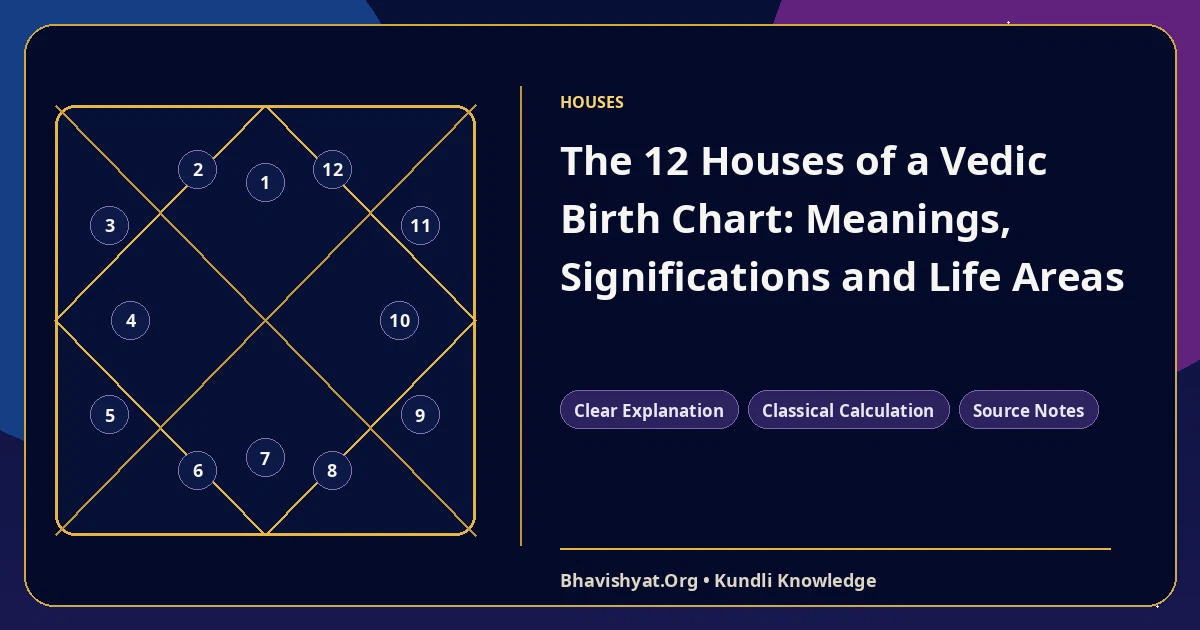 The 12 Houses of a Vedic Birth Chart: Meanings, Significations and Life Areas
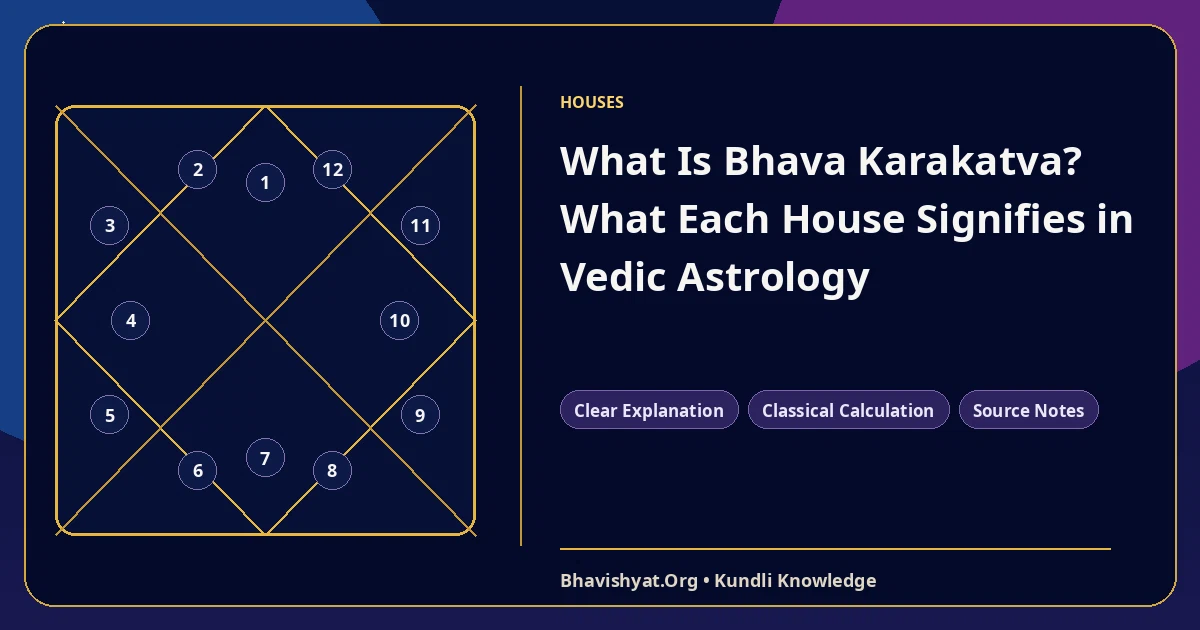 What Is Bhava Karakatva? What Each House Signifies in Vedic Astrology
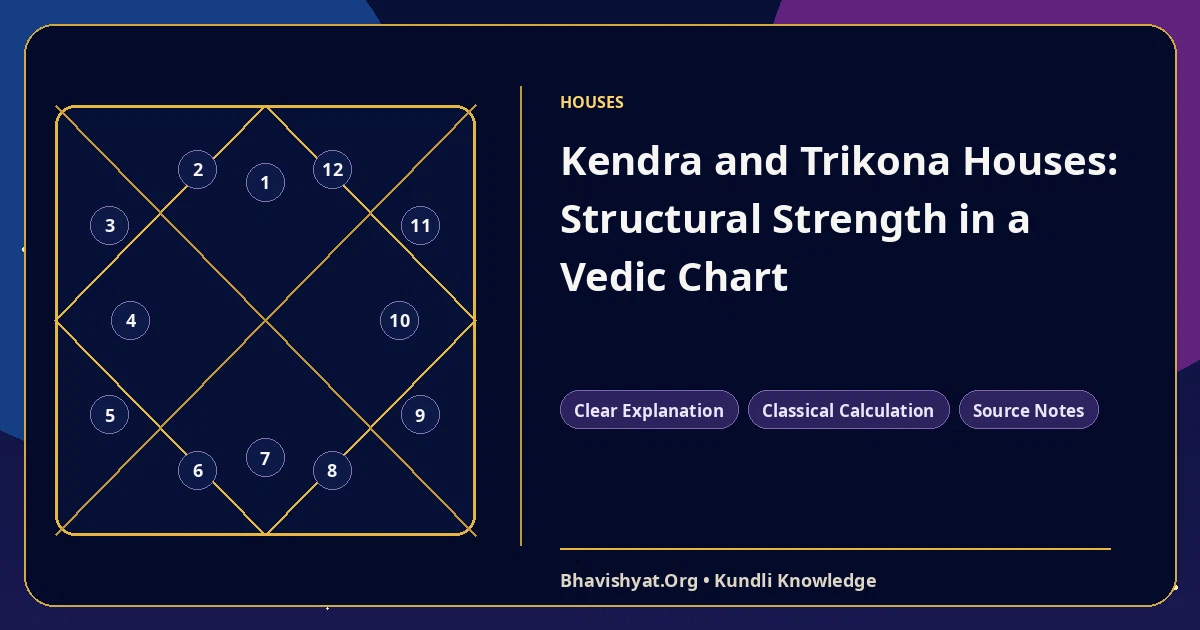 Kendra and Trikona Houses: Structural Strength in a Vedic Chart
 Upachaya Houses: Houses That Improve Through Effort and Time
 Trika Houses 6, 8 and 12: Correctly Understanding Difficult Houses
 1st House: Meaning, Significations, House Lord and Results in a Vedic Chart