
The lunar eclipse of 28 August 2026 is a deep partial eclipse. The principal partial phase falls roughly between 08:04 and 11:22 IST, with maximum eclipse around 09:43–09:44 IST. It is not visible from India, so the traditional rule of a locally observed sutak is not applied in India. For Jyotisha interpretation, however, the sidereal eclipse axis remains relevant as a symbolic timing factor: the Moon is in Aquarius in Shatabhisha, opposite the Sun in Leo in the Magha zone, with Mercury and Ketu also in Leo. Mars is in Gemini, Jupiter in Cancer, Venus in Virgo and retrograde Saturn in Pisces. The discussion below treats these positions as a framework for reflection and timing, not as a deterministic promise of events. The nakshatra guide uses the same eclipse facts only as a base for comparing Shatabhisha with each natal birth star.
How to use the nakshatra guide
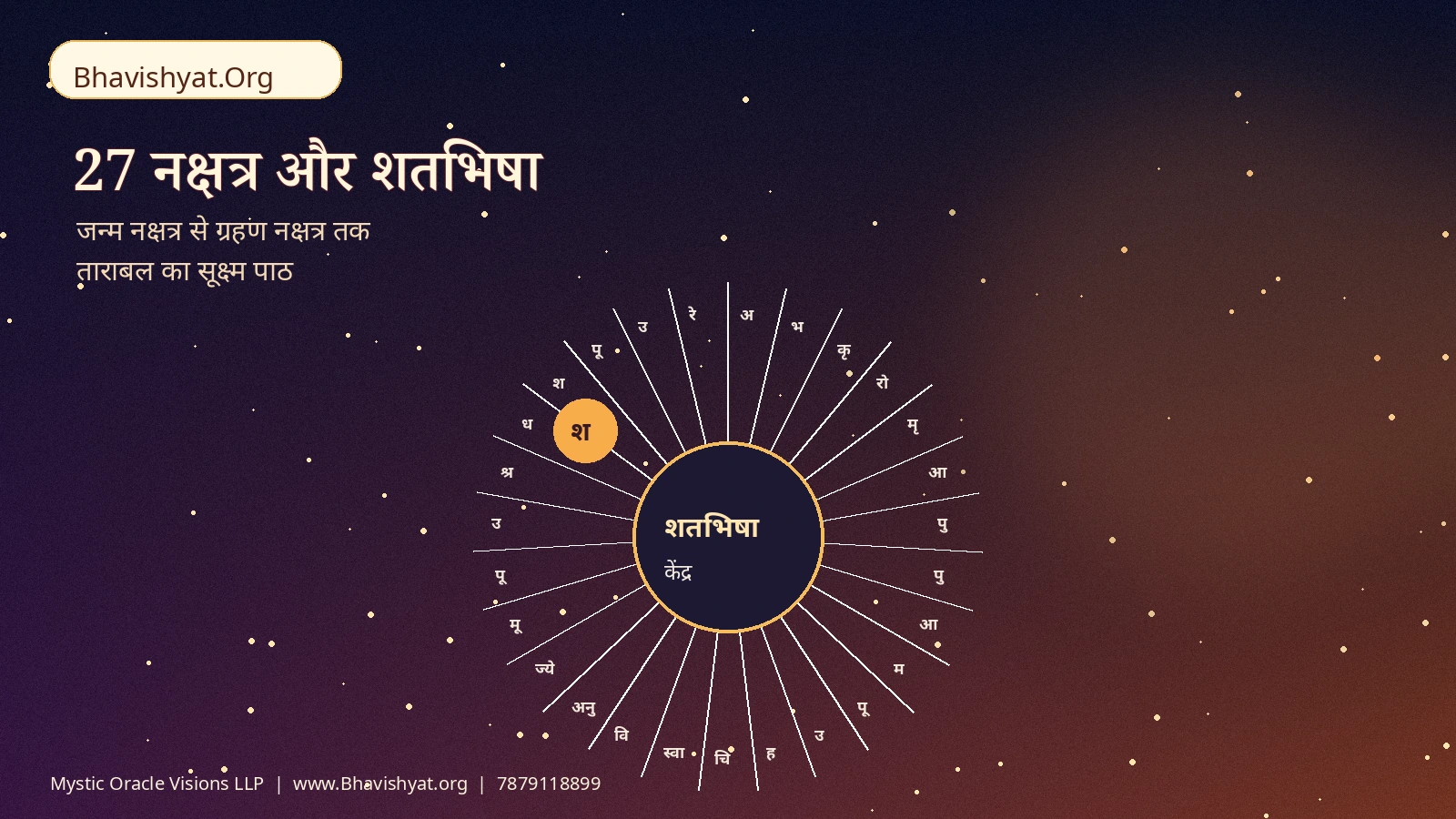
Find the nakshatra occupied by your natal Moon. The eclipse Moon is in Shatabhisha, so the guide compares your birth star with Shatabhisha through the traditional ninefold tara cycle. Tara classification is a secondary timing tool: it can describe whether the transit feels more supportive, demanding, obstructive or sensitive, but it does not replace the natal horoscope. Read your Moon sign article first, then use the paragraph for your birth nakshatra as a refinement. If you know the exact natal degree, pay additional attention when the Moon, ascendant or another sensitive natal point lies close to the Aquarius–Leo eclipse degrees.
The 27 birth nakshatras
Ashwini — Sadhaka Tara
For a natal Moon in Ashwini, Shatabhisha falls in the Sadhaka tara relationship, with an inclusive count of 24 nakshatras. The traditional emphasis is on focused effort, completion and the possibility of constructive progress. This does not forecast a fixed event. Use it as a behavioural clue: make decisions at a pace that matches the tara quality, verify the facts relevant to your Moon-sign house axis and avoid interpreting temporary emotional intensity as destiny. If a major matter is already active, the lord of Ashwini, the natal Moon’s strength and the operating dasha must be examined before the eclipse can be given decisive weight.
Bharani — Pratyari Tara
For a natal Moon in Bharani, Shatabhisha falls in the Pratyari tara relationship, with an inclusive count of 23 nakshatras. The traditional emphasis is on opposition, delay and the need for negotiation rather than force. This does not forecast a fixed event. Use it as a behavioural clue: make decisions at a pace that matches the tara quality, verify the facts relevant to your Moon-sign house axis and avoid interpreting temporary emotional intensity as destiny. If a major matter is already active, the lord of Bharani, the natal Moon’s strength and the operating dasha must be examined before the eclipse can be given decisive weight.
Krittika — Kshema Tara
For a natal Moon in Krittika, Shatabhisha falls in the Kshema tara relationship, with an inclusive count of 22 nakshatras. The traditional emphasis is on stability, restoration and the protection of what is already working. This does not forecast a fixed event. Use it as a behavioural clue: make decisions at a pace that matches the tara quality, verify the facts relevant to your Moon-sign house axis and avoid interpreting temporary emotional intensity as destiny. If a major matter is already active, the lord of Krittika, the natal Moon’s strength and the operating dasha must be examined before the eclipse can be given decisive weight.
Rohini — Vipat Tara
For a natal Moon in Rohini, Shatabhisha falls in the Vipat tara relationship, with an inclusive count of 21 nakshatras. The traditional emphasis is on friction, distraction and the importance of avoiding unnecessary risk. This does not forecast a fixed event. Use it as a behavioural clue: make decisions at a pace that matches the tara quality, verify the facts relevant to your Moon-sign house axis and avoid interpreting temporary emotional intensity as destiny. If a major matter is already active, the lord of Rohini, the natal Moon’s strength and the operating dasha must be examined before the eclipse can be given decisive weight.
Mrigashira — Sampat Tara
For a natal Moon in Mrigashira, Shatabhisha falls in the Sampat tara relationship, with an inclusive count of 20 nakshatras. The traditional emphasis is on resources, practical gains and the wise use of opportunities. This does not forecast a fixed event. Use it as a behavioural clue: make decisions at a pace that matches the tara quality, verify the facts relevant to your Moon-sign house axis and avoid interpreting temporary emotional intensity as destiny. If a major matter is already active, the lord of Mrigashira, the natal Moon’s strength and the operating dasha must be examined before the eclipse can be given decisive weight.
Ardra — Janma Tara
For a natal Moon in Ardra, Shatabhisha falls in the Janma tara relationship, with an inclusive count of 19 nakshatras. The traditional emphasis is on identity, emotional sensitivity and the need to observe before reacting. This does not forecast a fixed event. Use it as a behavioural clue: make decisions at a pace that matches the tara quality, verify the facts relevant to your Moon-sign house axis and avoid interpreting temporary emotional intensity as destiny. If a major matter is already active, the lord of Ardra, the natal Moon’s strength and the operating dasha must be examined before the eclipse can be given decisive weight.
Punarvasu — Ati-Mitra Tara
For a natal Moon in Punarvasu, Shatabhisha falls in the Ati-Mitra tara relationship, with an inclusive count of 18 nakshatras. The traditional emphasis is on stronger support, confidence and the productive use of goodwill. This does not forecast a fixed event. Use it as a behavioural clue: make decisions at a pace that matches the tara quality, verify the facts relevant to your Moon-sign house axis and avoid interpreting temporary emotional intensity as destiny. If a major matter is already active, the lord of Punarvasu, the natal Moon’s strength and the operating dasha must be examined before the eclipse can be given decisive weight.
Pushya — Mitra Tara
For a natal Moon in Pushya, Shatabhisha falls in the Mitra tara relationship, with an inclusive count of 17 nakshatras. The traditional emphasis is on support, cooperation and the value of trusted relationships. This does not forecast a fixed event. Use it as a behavioural clue: make decisions at a pace that matches the tara quality, verify the facts relevant to your Moon-sign house axis and avoid interpreting temporary emotional intensity as destiny. If a major matter is already active, the lord of Pushya, the natal Moon’s strength and the operating dasha must be examined before the eclipse can be given decisive weight.
Ashlesha — Naidhana Tara
For a natal Moon in Ashlesha, Shatabhisha falls in the Naidhana tara relationship, with an inclusive count of 16 nakshatras. The traditional emphasis is on fatigue, endings and the need to reduce exposure to avoidable strain. This does not forecast a fixed event. Use it as a behavioural clue: make decisions at a pace that matches the tara quality, verify the facts relevant to your Moon-sign house axis and avoid interpreting temporary emotional intensity as destiny. If a major matter is already active, the lord of Ashlesha, the natal Moon’s strength and the operating dasha must be examined before the eclipse can be given decisive weight.
Magha — Sadhaka Tara
For a natal Moon in Magha, Shatabhisha falls in the Sadhaka tara relationship, with an inclusive count of 15 nakshatras. The traditional emphasis is on focused effort, completion and the possibility of constructive progress. This does not forecast a fixed event. Use it as a behavioural clue: make decisions at a pace that matches the tara quality, verify the facts relevant to your Moon-sign house axis and avoid interpreting temporary emotional intensity as destiny. If a major matter is already active, the lord of Magha, the natal Moon’s strength and the operating dasha must be examined before the eclipse can be given decisive weight.
Purva Phalguni — Pratyari Tara
For a natal Moon in Purva Phalguni, Shatabhisha falls in the Pratyari tara relationship, with an inclusive count of 14 nakshatras. The traditional emphasis is on opposition, delay and the need for negotiation rather than force. This does not forecast a fixed event. Use it as a behavioural clue: make decisions at a pace that matches the tara quality, verify the facts relevant to your Moon-sign house axis and avoid interpreting temporary emotional intensity as destiny. If a major matter is already active, the lord of Purva Phalguni, the natal Moon’s strength and the operating dasha must be examined before the eclipse can be given decisive weight.
Uttara Phalguni — Kshema Tara
For a natal Moon in Uttara Phalguni, Shatabhisha falls in the Kshema tara relationship, with an inclusive count of 13 nakshatras. The traditional emphasis is on stability, restoration and the protection of what is already working. This does not forecast a fixed event. Use it as a behavioural clue: make decisions at a pace that matches the tara quality, verify the facts relevant to your Moon-sign house axis and avoid interpreting temporary emotional intensity as destiny. If a major matter is already active, the lord of Uttara Phalguni, the natal Moon’s strength and the operating dasha must be examined before the eclipse can be given decisive weight.
Hasta — Vipat Tara
For a natal Moon in Hasta, Shatabhisha falls in the Vipat tara relationship, with an inclusive count of 12 nakshatras. The traditional emphasis is on friction, distraction and the importance of avoiding unnecessary risk. This does not forecast a fixed event. Use it as a behavioural clue: make decisions at a pace that matches the tara quality, verify the facts relevant to your Moon-sign house axis and avoid interpreting temporary emotional intensity as destiny. If a major matter is already active, the lord of Hasta, the natal Moon’s strength and the operating dasha must be examined before the eclipse can be given decisive weight.
Chitra — Sampat Tara
For a natal Moon in Chitra, Shatabhisha falls in the Sampat tara relationship, with an inclusive count of 11 nakshatras. The traditional emphasis is on resources, practical gains and the wise use of opportunities. This does not forecast a fixed event. Use it as a behavioural clue: make decisions at a pace that matches the tara quality, verify the facts relevant to your Moon-sign house axis and avoid interpreting temporary emotional intensity as destiny. If a major matter is already active, the lord of Chitra, the natal Moon’s strength and the operating dasha must be examined before the eclipse can be given decisive weight.
Swati — Janma Tara
For a natal Moon in Swati, Shatabhisha falls in the Janma tara relationship, with an inclusive count of 10 nakshatras. The traditional emphasis is on identity, emotional sensitivity and the need to observe before reacting. This does not forecast a fixed event. Use it as a behavioural clue: make decisions at a pace that matches the tara quality, verify the facts relevant to your Moon-sign house axis and avoid interpreting temporary emotional intensity as destiny. If a major matter is already active, the lord of Swati, the natal Moon’s strength and the operating dasha must be examined before the eclipse can be given decisive weight.
Vishakha — Ati-Mitra Tara
For a natal Moon in Vishakha, Shatabhisha falls in the Ati-Mitra tara relationship, with an inclusive count of 9 nakshatras. The traditional emphasis is on stronger support, confidence and the productive use of goodwill. This does not forecast a fixed event. Use it as a behavioural clue: make decisions at a pace that matches the tara quality, verify the facts relevant to your Moon-sign house axis and avoid interpreting temporary emotional intensity as destiny. If a major matter is already active, the lord of Vishakha, the natal Moon’s strength and the operating dasha must be examined before the eclipse can be given decisive weight.
Anuradha — Mitra Tara
For a natal Moon in Anuradha, Shatabhisha falls in the Mitra tara relationship, with an inclusive count of 8 nakshatras. The traditional emphasis is on support, cooperation and the value of trusted relationships. This does not forecast a fixed event. Use it as a behavioural clue: make decisions at a pace that matches the tara quality, verify the facts relevant to your Moon-sign house axis and avoid interpreting temporary emotional intensity as destiny. If a major matter is already active, the lord of Anuradha, the natal Moon’s strength and the operating dasha must be examined before the eclipse can be given decisive weight.
Jyeshtha — Naidhana Tara
For a natal Moon in Jyeshtha, Shatabhisha falls in the Naidhana tara relationship, with an inclusive count of 7 nakshatras. The traditional emphasis is on fatigue, endings and the need to reduce exposure to avoidable strain. This does not forecast a fixed event. Use it as a behavioural clue: make decisions at a pace that matches the tara quality, verify the facts relevant to your Moon-sign house axis and avoid interpreting temporary emotional intensity as destiny. If a major matter is already active, the lord of Jyeshtha, the natal Moon’s strength and the operating dasha must be examined before the eclipse can be given decisive weight.
Mula — Sadhaka Tara
For a natal Moon in Mula, Shatabhisha falls in the Sadhaka tara relationship, with an inclusive count of 6 nakshatras. The traditional emphasis is on focused effort, completion and the possibility of constructive progress. This does not forecast a fixed event. Use it as a behavioural clue: make decisions at a pace that matches the tara quality, verify the facts relevant to your Moon-sign house axis and avoid interpreting temporary emotional intensity as destiny. If a major matter is already active, the lord of Mula, the natal Moon’s strength and the operating dasha must be examined before the eclipse can be given decisive weight.
Purva Ashadha — Pratyari Tara
For a natal Moon in Purva Ashadha, Shatabhisha falls in the Pratyari tara relationship, with an inclusive count of 5 nakshatras. The traditional emphasis is on opposition, delay and the need for negotiation rather than force. This does not forecast a fixed event. Use it as a behavioural clue: make decisions at a pace that matches the tara quality, verify the facts relevant to your Moon-sign house axis and avoid interpreting temporary emotional intensity as destiny. If a major matter is already active, the lord of Purva Ashadha, the natal Moon’s strength and the operating dasha must be examined before the eclipse can be given decisive weight.
Uttara Ashadha — Kshema Tara
For a natal Moon in Uttara Ashadha, Shatabhisha falls in the Kshema tara relationship, with an inclusive count of 4 nakshatras. The traditional emphasis is on stability, restoration and the protection of what is already working. This does not forecast a fixed event. Use it as a behavioural clue: make decisions at a pace that matches the tara quality, verify the facts relevant to your Moon-sign house axis and avoid interpreting temporary emotional intensity as destiny. If a major matter is already active, the lord of Uttara Ashadha, the natal Moon’s strength and the operating dasha must be examined before the eclipse can be given decisive weight.
Shravana — Vipat Tara
For a natal Moon in Shravana, Shatabhisha falls in the Vipat tara relationship, with an inclusive count of 3 nakshatras. The traditional emphasis is on friction, distraction and the importance of avoiding unnecessary risk. This does not forecast a fixed event. Use it as a behavioural clue: make decisions at a pace that matches the tara quality, verify the facts relevant to your Moon-sign house axis and avoid interpreting temporary emotional intensity as destiny. If a major matter is already active, the lord of Shravana, the natal Moon’s strength and the operating dasha must be examined before the eclipse can be given decisive weight.
Dhanishtha — Sampat Tara
For a natal Moon in Dhanishtha, Shatabhisha falls in the Sampat tara relationship, with an inclusive count of 2 nakshatras. The traditional emphasis is on resources, practical gains and the wise use of opportunities. This does not forecast a fixed event. Use it as a behavioural clue: make decisions at a pace that matches the tara quality, verify the facts relevant to your Moon-sign house axis and avoid interpreting temporary emotional intensity as destiny. If a major matter is already active, the lord of Dhanishtha, the natal Moon’s strength and the operating dasha must be examined before the eclipse can be given decisive weight.
Shatabhisha — Janma Tara
For a natal Moon in Shatabhisha, Shatabhisha falls in the Janma tara relationship, with an inclusive count of 1 nakshatras. The traditional emphasis is on identity, emotional sensitivity and the need to observe before reacting. This does not forecast a fixed event. Use it as a behavioural clue: make decisions at a pace that matches the tara quality, verify the facts relevant to your Moon-sign house axis and avoid interpreting temporary emotional intensity as destiny. If a major matter is already active, the lord of Shatabhisha, the natal Moon’s strength and the operating dasha must be examined before the eclipse can be given decisive weight.
Purva Bhadrapada — Ati-Mitra Tara
For a natal Moon in Purva Bhadrapada, Shatabhisha falls in the Ati-Mitra tara relationship, with an inclusive count of 27 nakshatras. The traditional emphasis is on stronger support, confidence and the productive use of goodwill. This does not forecast a fixed event. Use it as a behavioural clue: make decisions at a pace that matches the tara quality, verify the facts relevant to your Moon-sign house axis and avoid interpreting temporary emotional intensity as destiny. If a major matter is already active, the lord of Purva Bhadrapada, the natal Moon’s strength and the operating dasha must be examined before the eclipse can be given decisive weight.
Uttara Bhadrapada — Mitra Tara
For a natal Moon in Uttara Bhadrapada, Shatabhisha falls in the Mitra tara relationship, with an inclusive count of 26 nakshatras. The traditional emphasis is on support, cooperation and the value of trusted relationships. This does not forecast a fixed event. Use it as a behavioural clue: make decisions at a pace that matches the tara quality, verify the facts relevant to your Moon-sign house axis and avoid interpreting temporary emotional intensity as destiny. If a major matter is already active, the lord of Uttara Bhadrapada, the natal Moon’s strength and the operating dasha must be examined before the eclipse can be given decisive weight.
Revati — Naidhana Tara
For a natal Moon in Revati, Shatabhisha falls in the Naidhana tara relationship, with an inclusive count of 25 nakshatras. The traditional emphasis is on fatigue, endings and the need to reduce exposure to avoidable strain. This does not forecast a fixed event. Use it as a behavioural clue: make decisions at a pace that matches the tara quality, verify the facts relevant to your Moon-sign house axis and avoid interpreting temporary emotional intensity as destiny. If a major matter is already active, the lord of Revati, the natal Moon’s strength and the operating dasha must be examined before the eclipse can be given decisive weight.
Which birth stars need the closest attention?
Shatabhisha itself deserves the closest observation because the transit Moon occupies the same nakshatra. Magha is also important because the Sun occupies the opposite Leo region. Dhanishtha and Purva Bhadrapada border Shatabhisha and can become relevant when the natal Moon lies near the sign or nakshatra boundaries. The word ‘attention’ should not be confused with danger. It means that a person with a close natal contact may notice the themes more directly and should therefore use a complete horoscope if an important decision is underway.
Combining Moon sign, ascendant and nakshatra
Use three layers in order. First, the Moon sign shows the emotional and situational house axis. Second, the ascendant shows the concrete departments of life. Third, the nakshatra adds the quality of the lunar response and the tara relationship to Shatabhisha. If all three point toward one topic, that topic deserves more deliberate management. If they point in different directions, do not force a single dramatic conclusion; the dasha and natal strengths are needed to determine which layer is actually operative.
A final practical note
The eclipse is not visible in India, so this nakshatra guide is not a reason for fear or compulsory ritual. Use it to improve self-observation, communication and timing. A regular mantra or contemplative practice may be continued according to faith. Where a natal Moon is very close to the eclipse degree or a major life event is already unfolding, an individual chart analysis is the appropriate next step.