
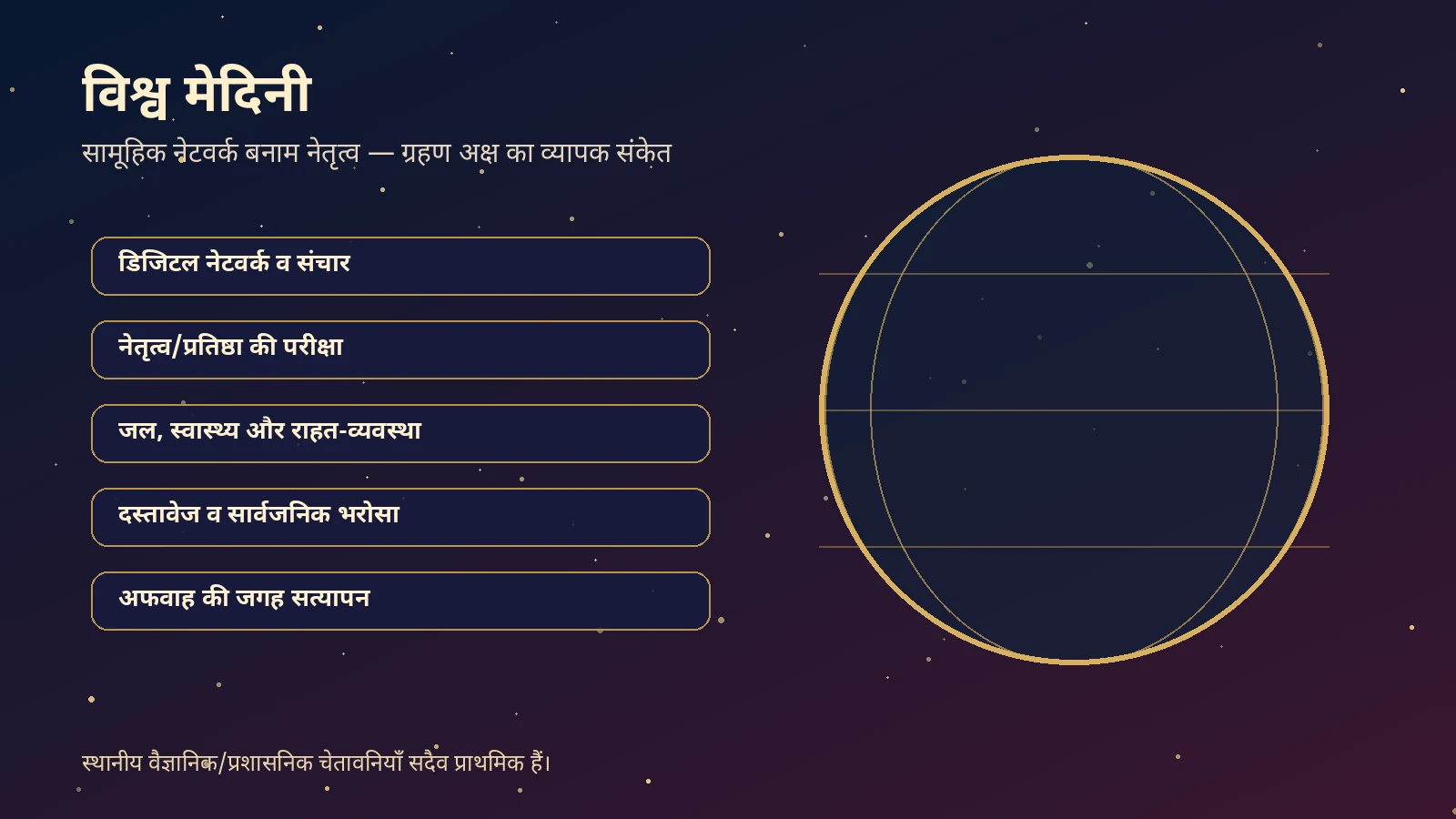
The lunar eclipse of 28 August 2026 is a deep partial eclipse. The principal partial phase falls roughly between 08:04 and 11:22 IST, with maximum eclipse around 09:43–09:44 IST. It is not visible from India, so the traditional rule of a locally observed sutak is not applied in India. For Jyotisha interpretation, however, the sidereal eclipse axis remains relevant as a symbolic timing factor: the Moon is in Aquarius in Shatabhisha, opposite the Sun in Leo in the Magha zone, with Mercury and Ketu also in Leo. Mars is in Gemini, Jupiter in Cancer, Venus in Virgo and retrograde Saturn in Pisces. The discussion below treats these positions as a framework for reflection and timing, not as a deterministic promise of events. For the world section, visibility zones and collective systems receive greater weight than India-specific ritual questions.
The world reading gives greater weight to regions where the eclipse is visible while still recognising that Aquarius themes—networks, technology, collective sentiment and distribution—are global by nature.
The main mundane theme: networks and leadership
Globally, the Aquarius–Leo eclipse axis places collective networks opposite visible authority. This can bring attention to the relationship between public sentiment and leadership, decentralised communication and central command, technological systems and institutional reputation. The symbolism is especially relevant where an existing controversy already involves legitimacy, access, censorship, platform governance or the distribution of resources. The eclipse does not create such issues from nothing; it can coincide with a period in which they become harder to ignore.
Give priority to the visibility zones
Mundane eclipse practice gives additional weight to the regions where the eclipse is actually visible. For this event the Pacific basin and substantial parts of the Americas have greater direct observational relevance than India. Even there, however, a forecast should be conditional. Political, environmental or economic developments require their own causes. The eclipse supplies timing symbolism and a field of attention, not a substitute for evidence.
Digital networks, data and communications
Aquarius is a natural symbolic fit for large-scale networks. The period is therefore suitable for watching platform policy, communications infrastructure, data governance, cyber-security narratives and the public consequences of technical outages or procedural changes. The prudent interpretation is resilience: institutions should review redundancy, authentication, public messaging and recovery plans. It would be irresponsible to announce a guaranteed global internet failure or cyberattack on the basis of an eclipse alone.
Water, public health and regulation
Shatabhisha carries a Varuna association that can be read through water, boundaries, diagnosis, regulation and collective care. In mundane work this draws attention to systems that protect populations rather than to a specific disease prediction. Water management, health administration, laboratory or regulatory scrutiny and the clarity of public advisories can become meaningful themes. Any real-world health conclusion must still come from medical and public-health evidence.
Transport, logistics and media
Large networks are not only digital. Ports, air routes, shipping, supply chains and mass media also belong to the field of circulation. Existing logistical stress can become more visible near an eclipse, especially when a small disruption is magnified by public attention. For companies and administrations, the practical advice is to keep contingency communication accurate and avoid speculative statements before operational facts are confirmed.
Politics and reputation
The Leo side of the axis gives prominence to leaders, heads of institutions, ceremonial authority and reputation. A leadership decision may be judged not only by its substance but also by tone and symbolism. Where an election, succession, legal inquiry or public controversy is already active, the eclipse period may intensify scrutiny. That is a sensitivity window, not a prediction that a particular leader must rise or fall.
Economy, capital and agreements
With Mercury close to the Sun and Venus in Virgo, details, documentation and terms of agreement deserve attention. Markets can react quickly to headlines, but a lunar eclipse alone is not a trading signal. In business and policy, the constructive use of the symbolism is to read clauses carefully, verify numbers, reconcile discrepancies and avoid making a long-term commitment solely because sentiment has become unusually intense.
Directional symbolism and Kurma Vibhaga
Classical directional schemes may be used as a supplementary lens, but they are not a modern geopolitical map. A responsible article avoids forcing ancient regional names onto present borders. Directional emphasis can be compared with eclipse visibility and with actual contemporary developments. If the real-world evidence does not support a proposed link, the astrological interpretation should remain tentative.
How long should the window be watched?
The immediate days around maximum eclipse are useful for observing shifts in mood, disclosure and emphasis. Mundane practitioners may also watch the subsequent lunar cycle and the activation of the eclipse degree by later transits. A long window should not become an excuse to claim every event as a fulfilment. The more distant an event is from the eclipse, the more additional astrological and factual evidence is required.
Constructive possibilities
An eclipse is not only a symbol of disruption. Aquarius can favour reform, wider access, technical problem-solving and collective cooperation, while Leo can favour accountable leadership and the restoration of confidence. Where institutions are willing to listen and networks are used responsibly, the period can support correction rather than crisis. That constructive possibility belongs in a balanced mundane forecast.
How to use this forecast
Treat these themes as areas to monitor alongside real information from governments, markets, weather services, health authorities and local institutions. A mundane astrology article is most useful when it improves attention and timing without replacing evidence. Where several independent factors point in the same direction, the signal deserves more weight; where they do not, restraint is the correct conclusion. For global readers, compare the symbolism with developments in the actual visibility regions.
Institutions under information pressure
One of the clearest modern expressions of the Aquarius–Leo polarity is the speed at which a local institutional decision can become a global information event. A regulator, corporation, government department or public figure may issue a statement for a limited audience and find it amplified within minutes. The mundane lesson is therefore procedural as much as symbolic: prepare accurate facts, designate credible spokespeople, correct errors early and distinguish preliminary information from final decisions. Where an institution already faces distrust, an eclipse period can make inconsistency more visible because collective attention is unusually concentrated.
Markets and financial sentiment
A lunar eclipse is not a buy or sell signal. Financial markets respond to liquidity, earnings, policy, geopolitics, rates, positioning and many other measurable forces. Astrology can at most add a timing layer to sentiment and attention. The Mercury–Sun emphasis in Leo and Venus in Virgo favour careful reading of statements, numbers and terms rather than impulsive interpretation. If a market is already volatile, headlines may travel faster than confirmation. The responsible response for public readers is risk control, diversification and verification, not a deterministic market call based on the eclipse alone.
Environmental themes without disaster prediction
Shatabhisha and Varuna symbolism naturally invite discussion of water, containment and collective systems. That symbolism can encourage attention to reservoirs, coastal management, public-health infrastructure and emergency coordination, especially in regions already experiencing seasonal stress. It does not justify forecasting a specific earthquake, storm or flood. Natural events require scientific monitoring. Mundane astrology is better used here as a language of preparedness: where ordinary risk already exists, maintain systems, communication and contingency planning instead of claiming certainty about an event that the chart alone cannot establish.