
The lunar eclipse of 28 August 2026 is a deep partial eclipse. The principal partial phase falls roughly between 08:04 and 11:22 IST, with maximum eclipse around 09:43–09:44 IST. It is not visible from India, so the traditional rule of a locally observed sutak is not applied in India. For Jyotisha interpretation, however, the sidereal eclipse axis remains relevant as a symbolic timing factor: the Moon is in Aquarius in Shatabhisha, opposite the Sun in Leo in the Magha zone, with Mercury and Ketu also in Leo. Mars is in Gemini, Jupiter in Cancer, Venus in Virgo and retrograde Saturn in Pisces. The discussion below treats these positions as a framework for reflection and timing, not as a deterministic promise of events. Here the same sky pattern is examined through classical categories, textual discipline and the limits of applying old geographical rules to the modern world.
Eclipses in classical Jyotisha
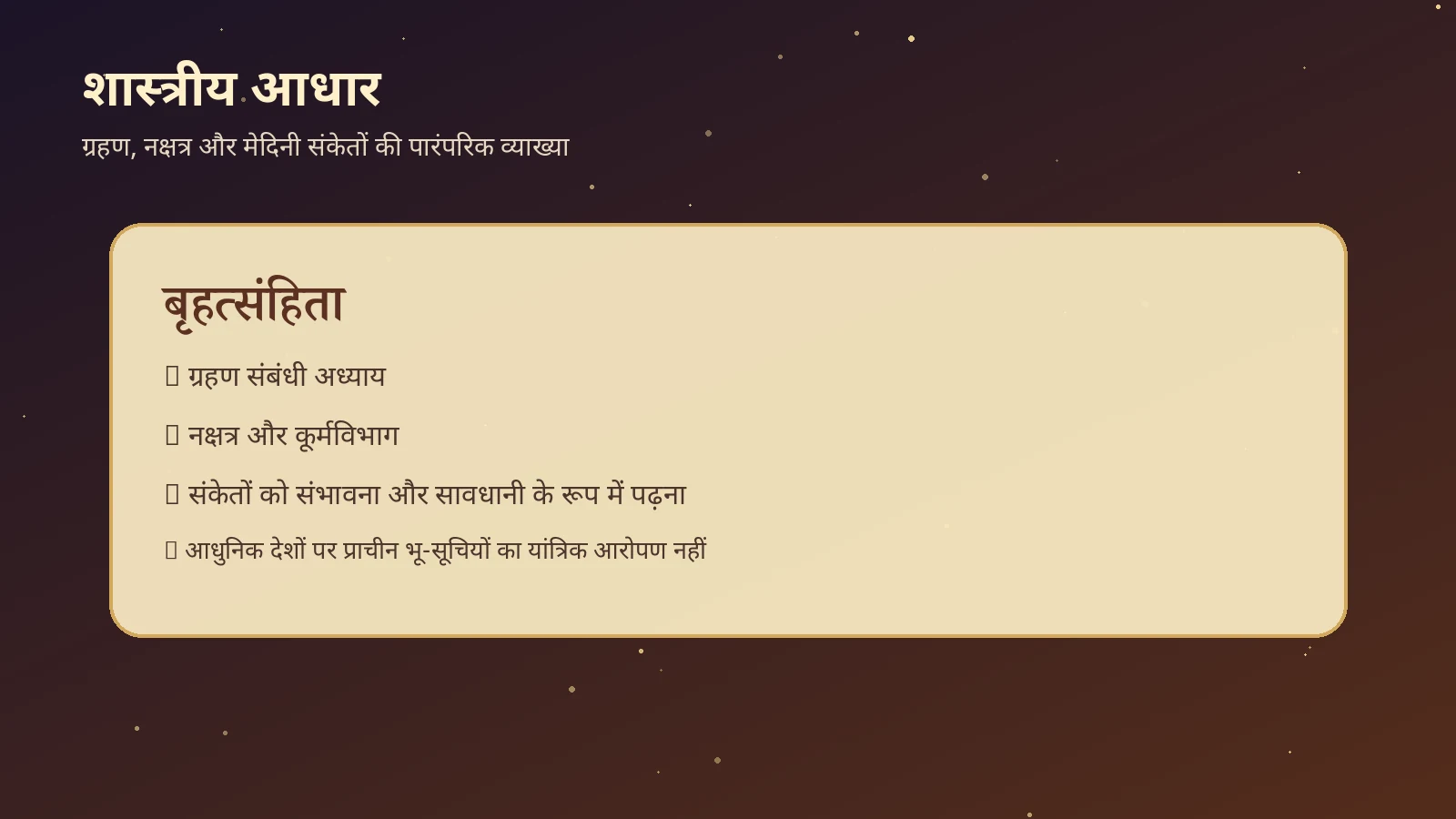
Classical Indian astronomical and astrological literature does not treat an eclipse as a licence for unlimited prediction. Works associated with eclipse calculation first establish the geometry and timing, while mundane traditions then discuss collective symbolism, visibility, direction and the stellar background. Brihat Samhita is especially important because it places celestial phenomena within a wider study of kingship, rainfall, agriculture, public order and regional omens. A modern reading should preserve that layered method: establish what is happening in the sky, identify where it is visible, then apply symbolism cautiously rather than converting every verse into a literal twenty-first-century headline.
Rahu and Ketu: astronomical point and astrological symbol
Rahu and Ketu are not physical planets. They are the two nodes where the Moon’s orbit intersects the ecliptic. Eclipses occur when the Sun and Moon come sufficiently close to this nodal axis at New Moon or Full Moon. In Jyotisha the nodes acquire a rich symbolic language—obscuration, amplification, discontinuity, foreign or unusual elements, breaks in continuity and the surfacing of what had been difficult to see. The astronomical definition and the astrological symbolism should be held together without confusing one for the other.
Aquarius and Leo as a mundane axis
Aquarius is associated with collective structures, large networks, circulation, social organisation and systems that distribute information or resources. Leo is associated with sovereign authority, leadership, reputation, central command and the visibility of those who represent an institution. The eclipse therefore lends itself to questions about the relationship between networks and leadership: how institutions communicate with the public, how technology mediates authority, how group pressure is absorbed and how leaders protect legitimacy without becoming inflexible.
Shatabhisha and the Varuna principle
Shatabhisha is traditionally linked with Varuna and carries themes of enclosure, law, observation, remedy, secrecy and the restoration of order. It should not be reduced to a modern keyword such as ‘technology’ or ‘medicine’, although those areas can resonate with its wider concern for systems and diagnosis. Under an eclipse, Shatabhisha can be read as a demand to inspect the integrity of a system: where are the boundaries weak, what has been hidden, which rule is not working, and what kind of repair requires patience rather than spectacle?
Magha, ancestry and legitimacy
Magha is associated with the Pitris, inherited status, lineage, dignity and the seat from which authority is exercised. When the Sun occupies this region opposite an eclipsed Moon in Shatabhisha, the symbolism can bring inherited structures into dialogue with modern networks and collective expectations. In a personal chart this may be experienced as a question of pride, family expectation or the desire to preserve a respected position. In mundane work it can describe the pressure on institutions to justify authority through conduct rather than title alone.
Using Kurma Vibhaga carefully
Kurma Vibhaga and related regional schemes belong to an old geographical imagination. They are valuable for understanding how classical authors linked directions, nakshatras and territories, but they should not be mechanically converted into a list of modern nation-states. Coastlines, borders and political units have changed. A responsible modern use treats these schemes as directional or regional clues and then checks them against actual eclipse visibility, contemporary geography and other mundane factors. This prevents a symbolic map from being presented as if it were a modern meteorological or geopolitical model.
Visibility and mundane relevance
Classical eclipse interpretation repeatedly gives importance to visibility. This does not mean that a non-visible eclipse has no symbolic value for a country; it means that the weight of direct local eclipse observance is lower. For India on 28 August 2026, this is a decisive distinction. The country can still be discussed in relation to the Aquarius–Leo axis, national charts, annual ingress or mundane themes, but the article should not use the same language that would be appropriate for a region where the Moon is visibly entering the Earth’s umbra.
Birth nakshatra and personal reading
The natal Moon’s nakshatra provides an additional personal layer. Traditional tara relationships classify the distance from the birth nakshatra to the transit nakshatra into a ninefold cycle. Such a calculation can identify whether the transit feels supportive, demanding, conflictual or draining, but it is never a complete judgement by itself. Natal Moon strength, its lord, dasha, the ascendant, divisional charts and exact contacts to the eclipse degrees remain necessary if a serious personal verdict is required.
The logic of remedies
A classical remedy is best understood as disciplined conduct that aligns the mind with a more constructive response. Mantra, charity, prayer, restraint and service are common because they reduce agitation and increase deliberateness. The remedy should not be sold as a mechanical cancellation of an eclipse. In India, where this eclipse is not visible, there is even less reason for fear-based ritual. A modest spiritual practice is sufficient for a general reader; specific remedial prescriptions should follow an individual horoscope rather than a generic sign article.
Three safeguards for reading classical texts
First, distinguish astronomical description from predictive symbolism. Second, preserve historical context before mapping an ancient region onto a modern state. Third, avoid deterministic language when several chart factors have not been examined. These safeguards do not weaken Jyotisha; they protect it from exaggeration. They also make public forecasts more useful because the reader can recognise a theme without being told that an uncertain event is inevitable.
How this knowledge centre applies the classical frame
The articles in this collection use the eclipse axis as a starting point, then separate mundane, Moon-sign, ascendant and nakshatra readings. The India section clearly states non-visibility, while the world section gives greater interpretive weight to the visibility zones. Sign articles describe house themes and practical caution; ascendant articles focus on concrete life departments; the nakshatra guide adds a stellar layer. Readers who need a personal judgement are directed to a complete horoscope analysis rather than encouraged to treat a general eclipse article as a final verdict.
Why a classical rule needs context
Classical texts were written for societies, political structures and geographical concepts very different from those of the present day. Their principles remain valuable, but application requires judgement. A reference to a ruler, a direction, a class of people or a region should first be understood in its textual setting. Only then should a modern analogue be considered. This prevents the common mistake of taking a vivid Sanskrit category and immediately converting it into a sensational modern headline. The stronger method is comparative: textual principle, astronomical visibility, current mundane chart factors and real-world context should point in a similar direction before the forecast becomes specific.
What makes an eclipse personally important
In natal work, proximity matters. A person whose Moon, ascendant, Sun or another important planet lies close to the eclipse degree may feel the period more sharply than someone who merely shares the same zodiac sign. Dasha activation matters as well. A sensitive degree without an operative period may remain latent, while a matching dasha can make the same transit more relevant. This is why sign-based public writing should identify themes and precautions but stop short of promising an event. Classical discipline is not about saying more; it is about knowing when the available factors are sufficient for a stronger judgement.