
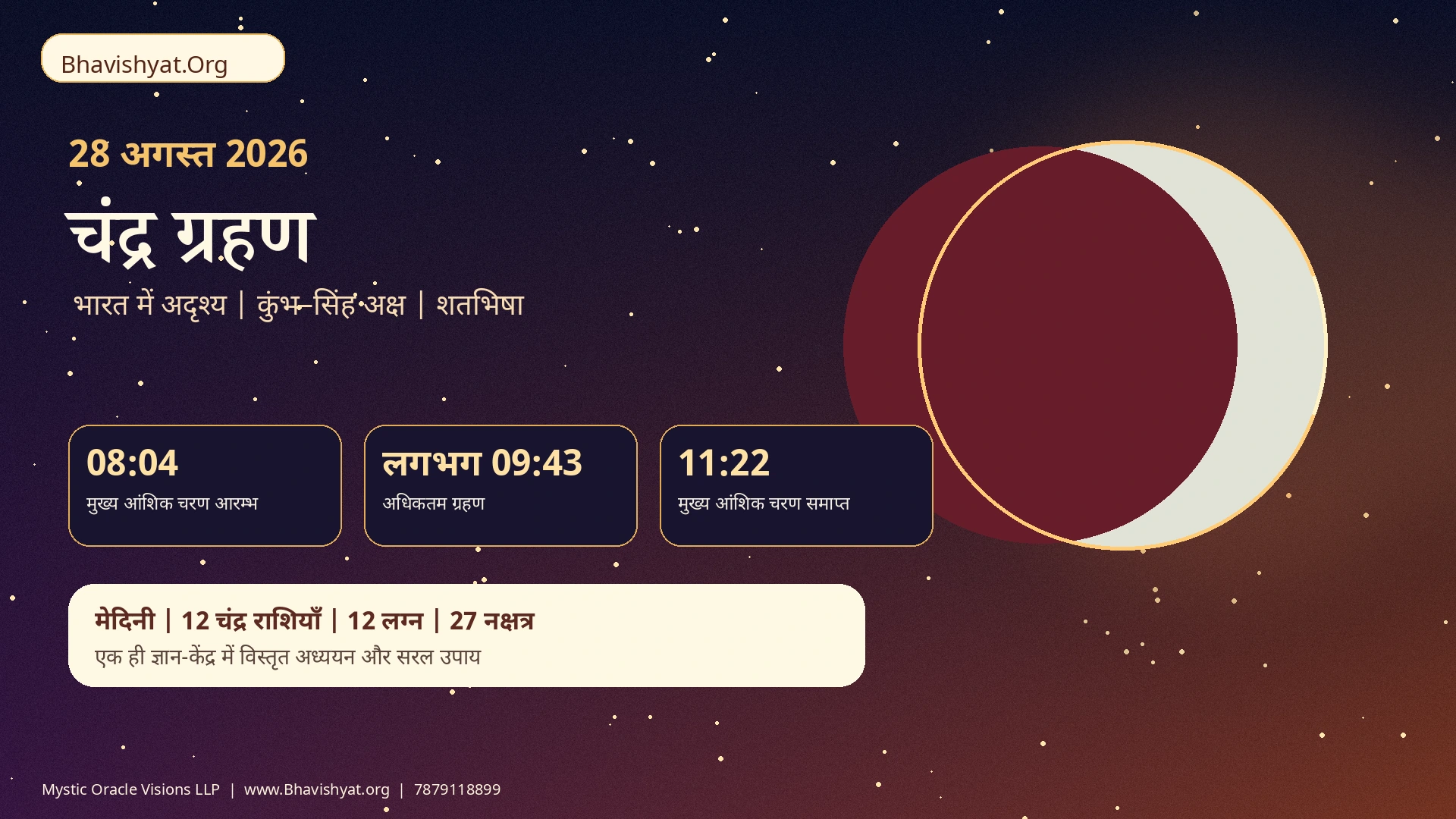
The lunar eclipse of 28 August 2026 is a deep partial eclipse. The principal partial phase falls roughly between 08:04 and 11:22 IST, with maximum eclipse around 09:43–09:44 IST. It is not visible from India, so the traditional rule of a locally observed sutak is not applied in India. For Jyotisha interpretation, however, the sidereal eclipse axis remains relevant as a symbolic timing factor: the Moon is in Aquarius in Shatabhisha, opposite the Sun in Leo in the Magha zone, with Mercury and Ketu also in Leo. Mars is in Gemini, Jupiter in Cancer, Venus in Virgo and retrograde Saturn in Pisces. The discussion below treats these positions as a framework for reflection and timing, not as a deterministic promise of events. This complete guide uses that framework to connect astronomy, mundane astrology and personal sign-based reading in one place.
What this eclipse actually is
A lunar eclipse occurs at Full Moon when the Earth moves between the Sun and the Moon and the Moon passes through the Earth’s shadow. On 28 August 2026 the alignment is strong enough to produce a deep partial eclipse rather than a total eclipse. That distinction matters. A large part of the lunar disc enters the umbra, but the Moon is not completely immersed. In practical terms, the sky event is visually dramatic where it can be seen, while in India the Moon has already set before the principal umbral phase. The first responsibility of a serious astrological article is therefore to separate visibility from symbolism. One should not create fear in a place where the eclipse is not seen, and one should not confuse a astronomical timing with a guaranteed personal event.
The sidereal axis: Aquarius and Leo
In the sidereal zodiac the eclipse falls across Aquarius and Leo. Aquarius represents networks, communities, systems, distribution, technology, shared resources and the behaviour of large groups. Leo represents authority, leadership, visibility, prestige, lineage and the need for a coherent centre. When an eclipse highlights this axis, the useful question is not ‘what disaster will happen?’ but ‘where is collective pressure meeting individual authority?’ In mundane astrology this can describe public debate, institutions, digital networks, administration, reputation and the way leaders respond to a changing social mood. In personal astrology the same axis moves to different houses depending on the Moon sign and ascendant, which is why a general forecast can never replace an individual chart.
Why Shatabhisha and Magha matter
The Moon occupies Shatabhisha, a nakshatra associated with Varuna, boundaries, rules, observation, healing, secrecy and the larger web that contains many individuals. Across the axis, the Sun occupies the Magha region, traditionally connected with ancestry, status, established authority and the weight of inherited structures. This does not mean that every person with a Shatabhisha or Magha connection will face the same event. It means that the eclipse language is shaped by two very different instincts: one wants systems to be transparent and functional, while the other wants continuity, dignity and legitimate command. The tension can be constructive when it produces reform without humiliation and leadership without rigidity.
How to read the India and world sections
Mundane astrology must be read with geographical discipline. Visibility is strongest across parts of the Pacific and the Americas, while India does not observe the eclipse directly. The world section therefore gives greater weight to regions where the eclipse is actually visible and then considers the global nature of the Aquarius themes—communications, networks, technology, collective sentiment and institutional response. The India section is deliberately more restrained. It studies the eclipse axis in relation to national timing factors and broad public themes, but it does not treat non-visibility as if the country were under a direct local eclipse ritual. This distinction is essential for responsible public writing.
How to use your Moon-sign reading
The Moon-sign section is intended to describe the way the eclipse may be experienced psychologically and circumstantially. Find the sign occupied by the natal Moon, then read the article for that sign. Each article identifies the Aquarius–Leo house axis from that Moon sign, explains work, finance, family, health and decision-making themes, and then separates the three nakshatra groups that fall within the sign. If you know your exact birth nakshatra, use that subsection as an additional layer rather than a substitute for the full sign reading. The closer your natal Moon or a sensitive planet is to the eclipse degrees, the more reason there is to study the individual chart rather than rely on a general article.
How to use your ascendant reading
The ascendant describes the structure of concrete life more directly: the body, role, responsibilities, home, partnerships, career and material circumstances. The ascendant article therefore asks where Aquarius and Leo fall as houses, then adds the positions of Mars, Jupiter, Venus and Saturn. Read the Moon sign first if your interest is emotional response and immediate mental tone; read the ascendant if you want to understand which life departments may demand management. When both Moon and ascendant point to the same theme—such as finances, partnerships or career—the theme deserves more attention, but even then the result depends on natal strength, dasha, divisional charts and exact degrees.
What not to do with an eclipse forecast
Do not turn a general eclipse article into a prediction of illness, separation, financial loss or political catastrophe. Eclipses concentrate attention and often coincide with disclosure, re-ordering, heightened emotion or a change in visibility, but the natal promise still has priority. Avoid impulsive financial bets merely because a house of speculation is activated. Avoid confrontational conversations merely because the Leo side of the axis appears prominent. And do not impose rituals intended for a visible local eclipse on people who are in India, where this eclipse is not observed. The most useful response is disciplined: verify information, allow emotional intensity to settle, finish pending work and make decisions after facts are clear.
Simple spiritual discipline
For those who wish to observe a spiritual discipline, keep it simple and non-commercial. A quiet period of mantra, prayer, meditation, charity or study is sufficient. ‘Om Namah Shivaya’ may be recited according to one’s capacity; so may a personal family mantra already used with faith. The point is not to perform an elaborate remedy out of fear. The point is to bring the mind under deliberate control at a time traditionally associated with shadow, obscuration and re-evaluation. In India, because the eclipse is not visible, normal daily duties may continue. Those who live in a region where the eclipse is visible should follow the local astronomical timing and their own family tradition.
When a personal horoscope is necessary
A personal judgement requires the birth time, place and date, and a complete review of the natal chart rather than the eclipse alone. The Moon, ascendant, relevant house lords, dasha, divisional charts, strength, aspects and current transits can either intensify or soften the general pattern. For example, an Aquarius eclipse in the tenth house does not automatically produce a job change; it may instead bring a change of responsibility, public visibility, a new reporting line, a delayed decision or simply a period of intense professional review. The purpose of this knowledge centre is to help you identify the right question. The individual chart is what decides whether that question becomes a major event, a minor adjustment or merely a passing concern.