
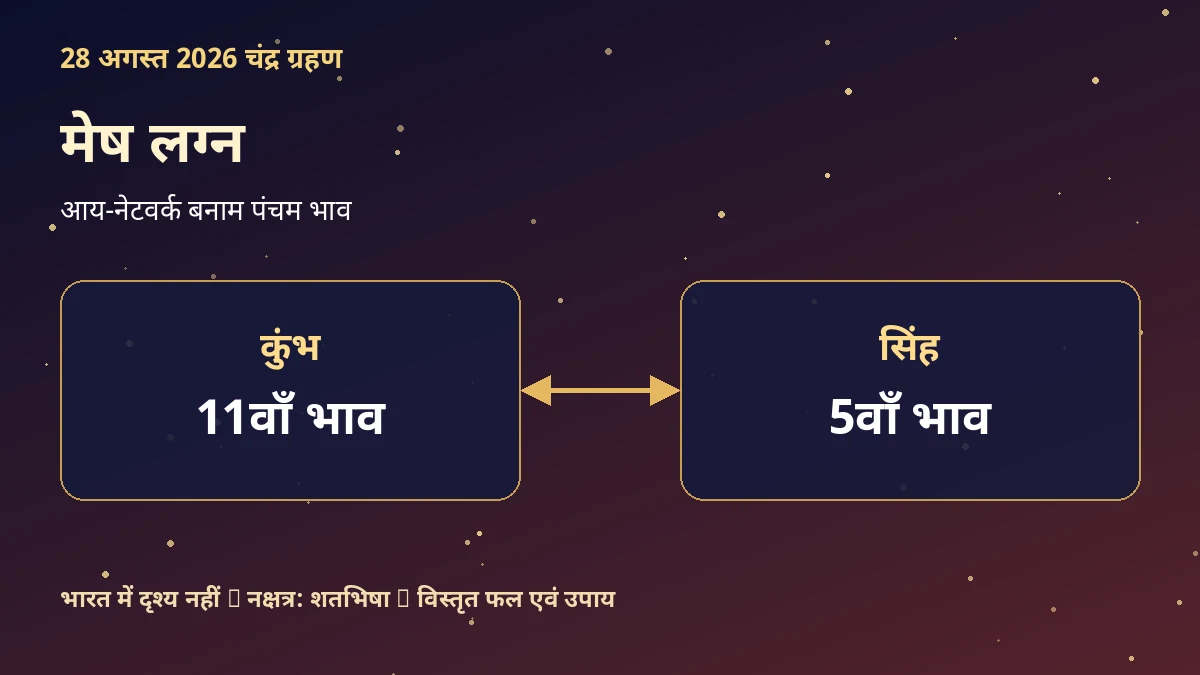
For Aries ascendant, the 28 August 2026 eclipse activates the 11th–5th house axis: income, gains, alliances, networks and future aims on the Aquarius side and children, learning, creativity, romance and judgement on the Leo side. The lunar eclipse of 28 August 2026 is a deep partial eclipse. The principal partial phase falls roughly between 08:04 and 11:22 IST, with maximum eclipse around 09:43–09:44 IST. It is not visible from India, so the traditional rule of a locally observed sutak is not applied in India. For Jyotisha interpretation, however, the sidereal eclipse axis remains relevant as a symbolic timing factor: the Moon is in Aquarius in Shatabhisha, opposite the Sun in Leo in the Magha zone, with Mercury and Ketu also in Leo. Mars is in Gemini, Jupiter in Cancer, Venus in Virgo and retrograde Saturn in Pisces. The discussion below treats these positions as a framework for reflection and timing, not as a deterministic promise of events.
The core house axis for Aries ascendant
Aquarius falls in the 11th house from Aries and Leo falls in the 5th. The eclipse therefore concentrates attention on a concrete tension between income, gains, alliances, networks and future aims and children, learning, creativity, romance and judgement. This is the structural layer of the ascendant reading. The Moon sign may describe how you feel about the situation, but the ascendant shows where practical management is likely to be required. If neither house is currently active through dasha, the eclipse may remain a background signal; if one of them is strongly activated, existing developments can demand faster clarification.
Career and business
Professional interpretation depends on how the 11th and 5th houses connect with work, authority and decision-making in your actual chart. For Aries ascendant, the eclipse can redirect attention toward income, gains, alliances, networks and future aims while the opposite side raises questions around children, learning, creativity, romance and judgement. Do not treat a tense meeting or sudden proposal as proof of a permanent career change. Ask what has genuinely changed in role, revenue, reporting, contract or responsibility. Mercury close to the Sun in Leo makes wording important; a written record is preferable to an assumption.
Money, property and obligations
Financial prudence is useful because eclipse periods often coincide with heightened attention rather than clear valuation. Review the houses governing income, gains, alliances, networks and future aims and children, learning, creativity, romance and judgement and identify any real financial connection already present—salary, household expenditure, property, tax, debt, investment or shared liability. The correct response is accounting, not fear. Reconcile balances, preserve emergency margin and postpone a speculative decision if the only reason for taking it is emotional urgency. If a major transaction is unavoidable, use professional documentation and independent verification.
Home, family and close relationships
The 11–5 axis also changes the way responsibility is distributed within relationships. A family member may need more attention, a partnership may require a new boundary, or a private concern may compete with an external obligation. For Aries ascendant, the most constructive approach is to define the practical issue before discussing motives. Eclipses can make people speak from accumulated emotion. A short delay, a written plan or a calmer second conversation can prevent an ordinary disagreement from becoming a symbolic battle about respect or control.
Body, routine and capacity
An ascendant reading must include the body because the lagna represents physical presence and functional capacity. There is no basis for diagnosing disease from a general eclipse. The useful message is to protect the routines that sustain judgement: sleep, hydration, meals, movement, medication already prescribed and reasonable limits on work. The activated 11th and 5th houses can describe where attention is being consumed; if that pressure begins to disturb basic rhythm, restore the routine before attempting to solve every external problem at once.
How the other planets modify the eclipse
Mars in the 3th house
Mars describes initiative, heat, competition and the willingness to act. In the 3th house it channels those qualities through communication, courage, skills, siblings and short journeys. This placement should be used as a modifier, not as an isolated verdict. When it supports the eclipse axis, it can provide a practical route for response; when it adds pressure, it asks for slower decisions, better boundaries and a willingness to correct what has been neglected.
Jupiter in the 4th house
Jupiter describes counsel, growth, protection, learning and the search for a larger perspective. In the 4th house it channels those qualities through home, property, emotional roots and domestic security. This placement should be used as a modifier, not as an isolated verdict. When it supports the eclipse axis, it can provide a practical route for response; when it adds pressure, it asks for slower decisions, better boundaries and a willingness to correct what has been neglected.
Venus in the 6th house
Venus describes agreements, comfort, attraction, value, aesthetics and the wish for harmony. In the 6th house it channels those qualities through workload, health routines, debts, competition and service. This placement should be used as a modifier, not as an isolated verdict. When it supports the eclipse axis, it can provide a practical route for response; when it adds pressure, it asks for slower decisions, better boundaries and a willingness to correct what has been neglected.
Retrograde Saturn in the 12th house
Retrograde Saturn describes responsibility, delay, review, endurance and the need to repair structure. In the 12th house it channels those qualities through rest, expenses, foreign links, withdrawal, sleep and release. This placement should be used as a modifier, not as an isolated verdict. When it supports the eclipse axis, it can provide a practical route for response; when it adds pressure, it asks for slower decisions, better boundaries and a willingness to correct what has been neglected.
Putting the four modifiers together
For Aries ascendant, Mars, Jupiter, Venus and Saturn distribute the eclipse pressure across four additional life departments. This is why a single house-axis statement is never sufficient. Mars shows where action becomes immediate; Jupiter shows where perspective or support can be found; Venus shows where value, agreement or comfort must be refined; Saturn shows where an old responsibility cannot be bypassed. If several of these houses connect to the same real-life matter—for example a career decision that also changes income and family routine—the matter deserves careful planning rather than a dramatic yes-or-no reaction.
What to watch after the eclipse
Watch what remains active after the first emotional wave. A genuine eclipse-linked development usually has a prior foundation and continues to unfold through later transits, rather than appearing as a random event with no context. Keep notes on decisions, messages and commitments made near the eclipse. If clarity improves after a few days, act from that clearer position. If uncertainty persists, check the dasha and the natal promise before assigning the issue to the eclipse. For Aries ascendant, review this specifically through the houses and planetary modifiers described above rather than through a generic eclipse rule.
Practical conduct and simple remedy
The most useful general remedy for Aries ascendant is disciplined conduct in the houses actually activated. Keep commitments realistic, avoid unnecessary argument and make space for a quiet spiritual routine. A simple Shiva mantra, meditation or charity may be undertaken according to faith. Since the eclipse is not visible in India, there is no need to impose ritual fear. The astrological objective is steadiness: use the period to correct structure, not to search for a supernatural shortcut.
When a full horoscope reading is justified
A Aries ascendant article cannot decide a major event by itself. A proper judgement requires the natal lords of the 11th and 5th houses, their strength and aspects, the current mahadasha and antardasha, relevant divisional charts and the exact distance of natal planets from the eclipse degrees. If you are considering marriage, separation, a job change, property, a large investment or a medical decision, use the general article only to frame the question and then examine the complete horoscope.
How to keep the axis balanced for Aries ascendant
The two houses work better when neither is allowed to consume all available time, money or emotional attention. The Aries ascendant has to coordinate gains and networks with creativity and children, while Mars in the third, Jupiter in the fourth, Venus in the sixth and Saturn in the twelfth distribute effort across four additional houses. This creates a recognisable planning problem: one visible decision may have consequences in several departments at once. Write down the proposed action, then list what it changes in cash flow, family time, workload and long-term responsibility. If the same action improves one area but weakens two others, redesign the plan before announcing it. That is a more useful application of the eclipse than waiting for an external event.
How the four planetary modifiers can be used
For Aries ascendant, treat Mars in the third as the place where action becomes immediate, Jupiter in the fourth as the place where advice or expansion is available, Venus in the sixth as the place where value and agreement need refinement, and Saturn in the twelfth as the place where an old responsibility demands patience. The four placements should not be merged into one generic “good” or “bad” score. They describe different jobs. If a career decision is active, for example, ask which placement governs the conversation, which one governs the resources and which one describes the cost of delay. The chart becomes clearer when each planet is assigned a practical role.
A real-world test for the Aries axis
Suppose a matter involving gains and networks begins to interfere with creativity and children. The Aries approach should be to define the minimum acceptable outcome for both sides. Then test the available options against that minimum. If an option solves gains and networks but permanently damages creativity and children, it is probably not balanced. If an option protects creativity and children by refusing every change in gains and networks, it may be equally rigid. The eclipse can be read as a demand for a better trade-off, especially where pride, public visibility or group pressure is distorting the decision.
Documentation and accountability
Because Mercury is close to the Sun on the Leo side, Aries ascendant benefits from written clarity. Put deadlines, payment terms, responsibilities and conditions in a form that can be checked later. This is particularly important when gains and networks intersects with creativity and children. A verbal promise can feel sufficient in a calm week and become ambiguous when several people are under pressure. Clear documentation is not pessimism; it is a way of preventing the eclipse period’s heightened perception from turning an ordinary misunderstanding into a larger conflict.
When the Aries ascendant should seek a full chart review
A full review is justified when the decision under consideration is expensive, irreversible or relationally important and when the natal chart repeats the same houses. Check whether the lords connected with gains and networks and creativity and children are operating by dasha, whether the eclipse degree closely contacts a natal planet and whether the relevant divisional chart supports the proposed result. For Aries ascendant, this is especially important if the four modifiers—Mars in the third, Jupiter in the fourth, Venus in the sixth and Saturn in the twelfth—also converge on the same subject. Multiple confirmations increase relevance; one isolated transit does not lock the verdict.