
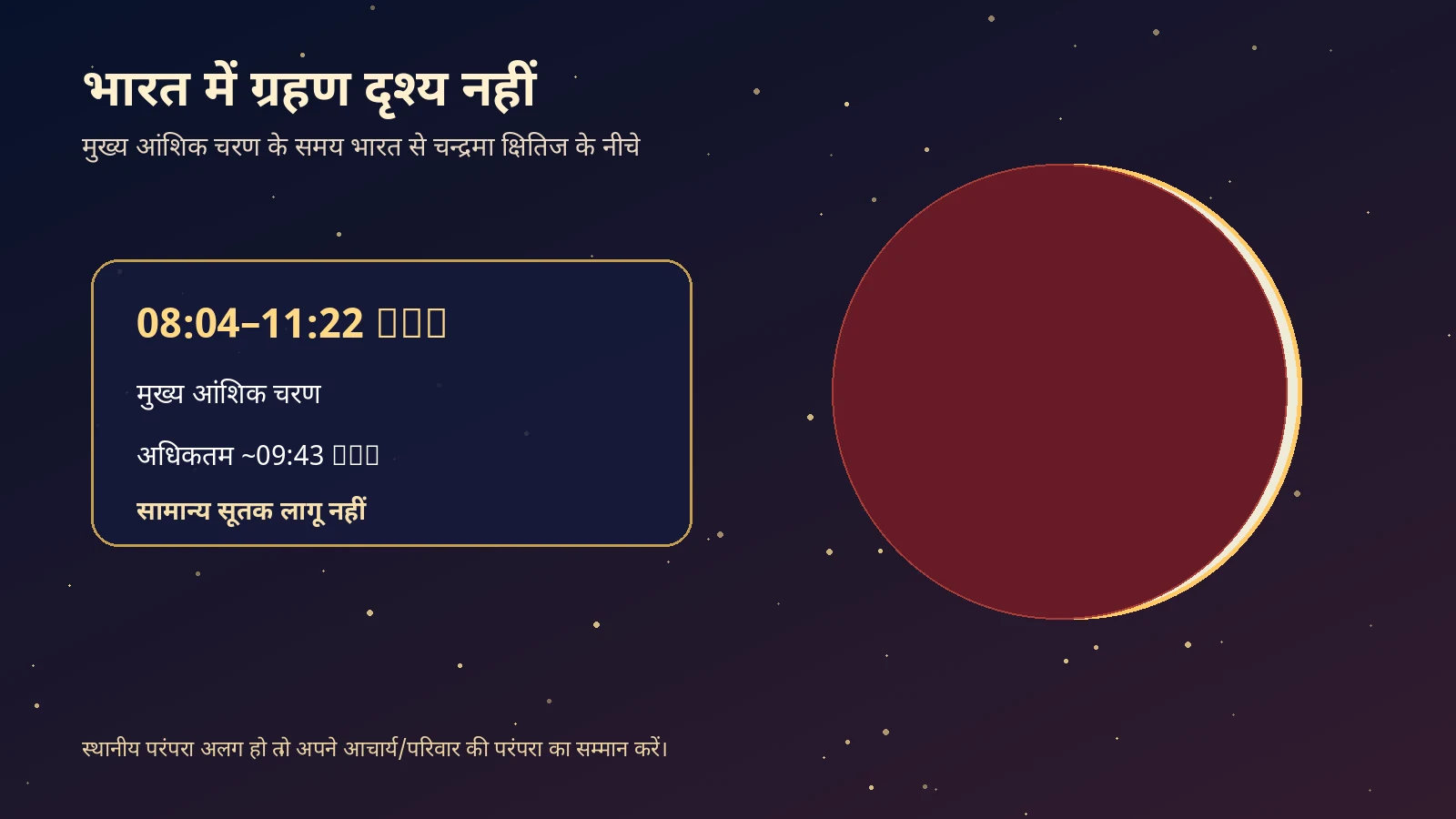
The lunar eclipse of 28 August 2026 is a deep partial eclipse. The principal partial phase falls roughly between 08:04 and 11:22 IST, with maximum eclipse around 09:43–09:44 IST. It is not visible from India, so the traditional rule of a locally observed sutak is not applied in India. For Jyotisha interpretation, however, the sidereal eclipse axis remains relevant as a symbolic timing factor: the Moon is in Aquarius in Shatabhisha, opposite the Sun in Leo in the Magha zone, with Mercury and Ketu also in Leo. Mars is in Gemini, Jupiter in Cancer, Venus in Virgo and retrograde Saturn in Pisces. The discussion below treats these positions as a framework for reflection and timing, not as a deterministic promise of events. In this article the emphasis remains on timing, horizon visibility and the distinction between astronomical contacts and local ritual practice.
Eclipse timing in Indian Standard Time
The most useful times for readers in India are the times of the principal umbral phase, even though the eclipse itself is not visible from India. The partial phase begins at about 08:04 IST, reaches its maximum around 09:43–09:44 IST and ends around 11:22 IST. Different astronomical tables may round by a minute, so the practical emphasis should be on the phase rather than on a single second. The penumbral phase begins earlier and ends later, but it is subtle to the eye. If you are outside India, always convert the published universal time to the local civil time of the place from which you will observe the event.
Why a partial eclipse can still be deep
The word ‘partial’ describes geometry, not weakness. In this eclipse most of the lunar disc enters the Earth’s umbra, leaving only a small portion outside the deep shadow at maximum. That makes it visually substantial in regions where the Moon is above the horizon. A total eclipse would require the entire Moon to enter the umbra. This distinction is important because public posts often use ‘partial’ to suggest a minor event or use dramatic photographs of totality to advertise a partial eclipse. The correct description is a deep partial lunar eclipse: visually strong where visible, but not total.
Why India does not see it
Visibility is a simple question of whether the Moon is above the local horizon during the relevant phase. Across India the Moon sets before the main umbral eclipse develops. In Ujjain, which is the reference location used in this knowledge centre for sidereal and panchanga work, the Moon is already below the horizon by the time the principal partial phase begins. This is why the Indian ritual conclusion differs from the astrological discussion. An eclipse may be globally real and astrologically timed, yet locally invisible. The two statements are not contradictory.
Where the eclipse is visible
The eclipse is best placed for observers across the Pacific basin and large parts of the Americas, with visibility extending into regions whose local horizon keeps the Moon above the sky during the umbral phase. Exact circumstances vary by city. Someone travelling abroad should not rely on an India-based social-media graphic. Check the local contact times, moonrise and moonset for the observing place. The same rule applies to ritual practice: the traditional observance is linked to local visibility and local timing, not merely to the calendar date printed in India.
The Full Moon condition
Every lunar eclipse occurs at Full Moon, but not every Full Moon becomes an eclipse. The lunar orbit is tilted to the ecliptic, so most Full Moons pass above or below the Earth’s shadow. An eclipse requires the Full Moon to occur close enough to the lunar nodes. In Jyotisha, the nodes are called Rahu and Ketu. Astronomically they are intersection points of the lunar orbit with the ecliptic; astrologically they have a long symbolic tradition. Keeping the geometric and symbolic meanings distinct makes the interpretation more rigorous.
Sidereal planetary positions near maximum
Using a Lahiri sidereal framework near the time of maximum eclipse, the Moon lies in Aquarius in Shatabhisha and the Sun lies opposite in Leo in the Magha region. Mercury is close to the Sun in Leo, Ketu occupies the same sign, Mars is in Gemini, Jupiter is in Cancer, Venus is in Virgo and Saturn is retrograde in Pisces. The mean lunar node places Rahu in Aquarius. Small differences in the exact node degree appear when mean and true-node methods are compared, but both methods preserve the same Aquarius–Leo eclipse axis and the same broad nakshatra context.
Mean node and true node
A mean node is a mathematically smoothed position of the lunar node; the true node includes the node’s short-term oscillation. Both are used by established Jyotisha practitioners. For this eclipse the difference is not large enough to alter the sign axis. A forecast should therefore avoid pretending that a small numerical difference creates an entirely different eclipse. If an individual horoscope has a planet within a very tight degree range, the choice of node model can matter for precision, but the general public interpretation remains anchored in Aquarius, Leo, Shatabhisha and Magha.
Sutak in India
For India the practical answer is straightforward: because the eclipse is not visible, the ordinary rule of observing eclipse sutak is not applied. There is no need to stop routine work, discard food or impose restrictions on children, older people or pregnant women simply because the eclipse is occurring elsewhere on Earth. Families may still choose to pray, meditate or recite a mantra, but that is a voluntary spiritual discipline rather than a compulsory response to a locally visible eclipse.
Common timing mistakes
Three mistakes are especially common. First, a universal time is copied and labelled as IST without conversion. Second, the penumbral start is presented as if the visible partial eclipse had already begun. Third, a global eclipse map is used to claim visibility in every country. Readers should look for the local horizon, the umbral phase and the local time zone. In astrological writing a fourth mistake appears when the eclipse date is treated as a single instant. The symbolic window can be discussed around the event, but any precise event judgement must still be tied to the natal chart and its operative periods.
If you are outside India
If you live or travel in a region where the eclipse is visible, use the local eclipse contact times for observation and any family ritual. Do not use the Indian conclusion on sutak as a universal rule. Likewise, if you are in India, do not import a North American or Pacific observance schedule without adjustment. The astronomical event is global; the horizon is local. This simple distinction prevents most of the confusion that surrounds eclipse posts on social media.
Observation, photography and public communication
Where the eclipse is visible, safe observation is straightforward because a lunar eclipse does not require solar filters. The main challenge is timing and horizon conditions, not eye safety. Photographers should check local moon altitude and weather, while public communicators should label images honestly and avoid using photographs of a total eclipse to represent a partial one. For readers in India, live streams from visibility regions may be used for educational interest, but watching a stream does not change the local ritual status of the eclipse. The local horizon remains the decisive factor for visibility.
Why astronomical accuracy strengthens Jyotisha
Precise astronomy does not compete with Jyotisha; it gives the astrological interpretation a trustworthy foundation. Correct contact times, the correct sign and nakshatra, and a clear statement about visibility prevent later confusion. Once the sky facts are fixed, symbolic analysis can proceed without needing to exaggerate them. This is particularly important with eclipses because dramatic claims spread quickly. A disciplined article should be able to tell a reader exactly what is astronomical fact, what is traditional interpretation and what remains a conditional personal judgement.