
The lunar eclipse of 28 August 2026 is a deep partial eclipse. The principal partial phase falls roughly between 08:04 and 11:22 IST, with maximum eclipse around 09:43–09:44 IST. It is not visible from India, so the traditional rule of a locally observed sutak is not applied in India. For Jyotisha interpretation, however, the sidereal eclipse axis remains relevant as a symbolic timing factor: the Moon is in Aquarius in Shatabhisha, opposite the Sun in Leo in the Magha zone, with Mercury and Ketu also in Leo. Mars is in Gemini, Jupiter in Cancer, Venus in Virgo and retrograde Saturn in Pisces. The discussion below treats these positions as a framework for reflection and timing, not as a deterministic promise of events. For India, non-visibility is kept central so that mundane themes are discussed without importing a direct local eclipse ritual.
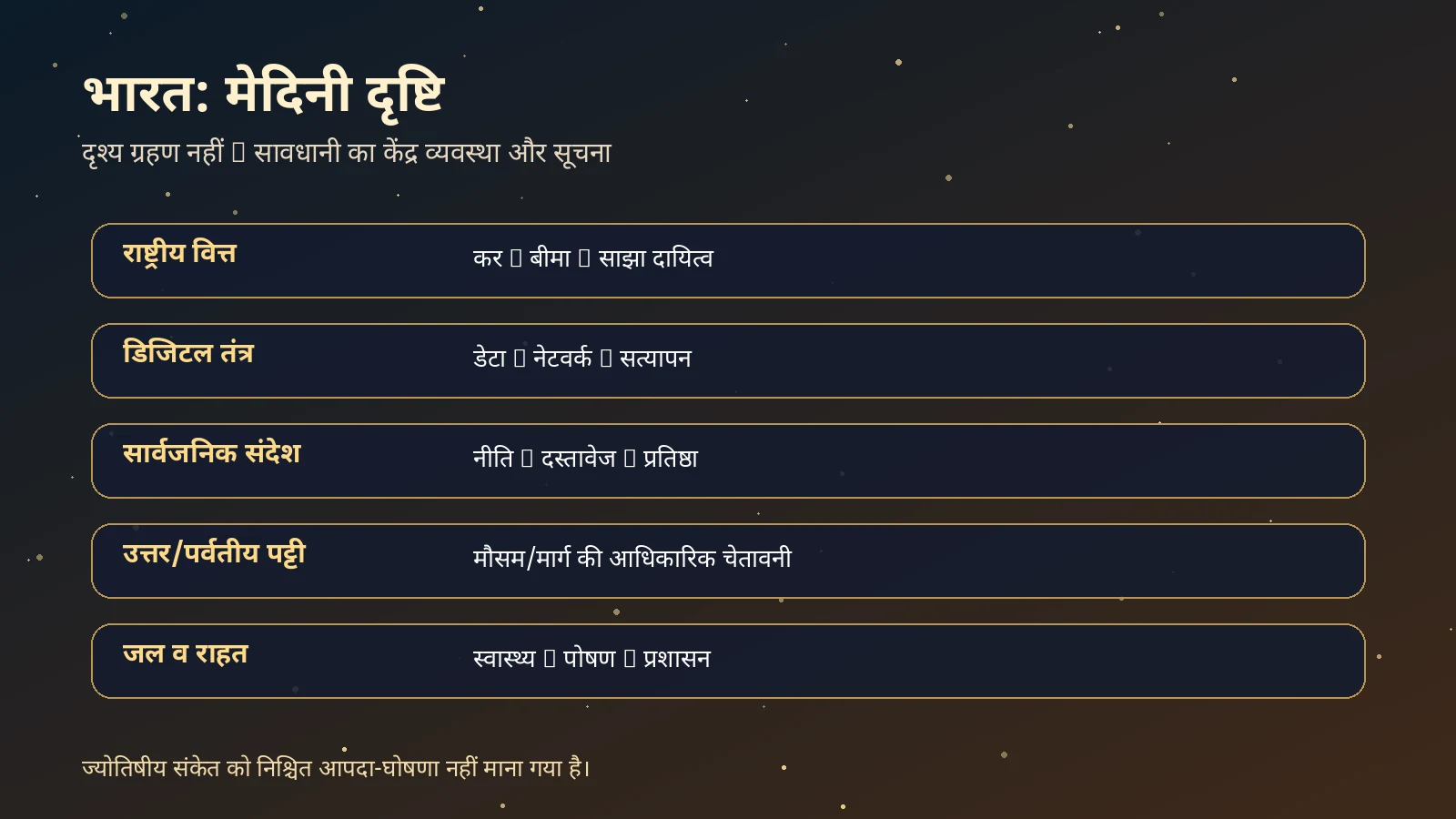
India does not see the eclipse directly, so the Indian mundane reading is deliberately restrained. The useful themes are institutional communication, digital networks, shared resources, public confidence and administrative preparedness.
No local sutak in India
The first public fact should remain unambiguous: the 28 August 2026 lunar eclipse is not visible in India. Consequently the ordinary local observance of eclipse sutak is not applied. This is important because mundane astrology and ritual observance are not the same thing. A country may still be discussed through its national timing factors and through the symbolism of a global eclipse, but a non-visible eclipse should not be described to Indian readers as if the Moon were visibly darkening above them.
Why a mundane India reading is still possible
Mundane astrology studies collective timing through several layers: national charts, annual ingress or year charts, transits, lunations and prominent celestial phenomena. The eclipse therefore becomes one factor among several. The Aquarius–Leo axis can be used to examine the relationship between public networks and authority, digital systems and official communication, collective expectations and leadership response. The appropriate language is one of sensitivity and watchfulness, not certainty.
Finance, obligations and shared resources
For India the eclipse period can be read as a time to watch areas involving shared liabilities, insurance, taxation, banking processes, institutional settlements and the management of obligations. This does not forecast a financial crisis. It suggests that documentation, reconciliation, compliance and communication around shared resources deserve additional care. Where policy announcements are already pending, the eclipse symbolism may coincide with sharper public attention or the need to clarify an existing rule.
Government and official communication
With the solar side of the eclipse in Leo, the conduct and tone of authority become prominent. Official statements, leadership symbolism, institutional reputation and the management of public expectations can attract disproportionate attention. A small communication error can appear larger when social networks amplify it. The constructive response is precise wording, transparent procedure and a willingness to correct misinformation quickly rather than allowing a narrative vacuum to form.
Digital systems and identity infrastructure
Aquarius naturally brings networks, platforms and large systems into the frame. In modern India this can include digital public infrastructure, identity processes, communications, payment networks, data management and high-volume citizen interfaces. The eclipse does not predict a cyber incident; it advises resilience. Backup systems, accurate public advisories, fraud awareness and careful verification of viral messages are sensible mundane expressions of the symbolism.
Northern and Himalayan sensitivity
Classical directional schemes can make the northern sector symbolically noteworthy, but this should be stated carefully. It is not a scientific weather forecast and does not justify naming a particular disaster. In practical terms, administrations and travellers should follow ordinary official weather, road and landslide advisories, especially during the monsoon season. Mundane astrology is most responsible when it encourages preparedness without claiming that an eclipse has guaranteed a specific natural event.
Water, health and relief systems
Shatabhisha and Varuna symbolism makes systems connected with water, public health, regulation and collective welfare relevant for observation. This can be read constructively: hospitals, municipal services, relief networks and public information systems benefit from clear procedure and redundancy. It would be inappropriate to convert this symbolism into a prediction of epidemic or disaster. The emphasis is on institutional readiness and the capacity to respond calmly if ordinary seasonal pressures arise.
Agriculture and rural economy
Late August is already agriculturally sensitive in many parts of India. The eclipse symbolism can be used to emphasise accurate information, irrigation management, logistics, crop-market communication and the timely resolution of local administrative bottlenecks. It should not replace meteorological data. Farmers and traders need actual rainfall, reservoir, transport and market information; the astrological layer is useful only as an additional caution against acting on rumour or delayed documentation.
Public mood and social media
The Aquarius–Leo polarity can sharpen the contrast between mass sentiment and centralised messaging. Social platforms may accelerate outrage, pride, identity-based narratives or calls for accountability. The most constructive collective response is to verify claims before forwarding them, avoid edited clips without context and distinguish an official notification from commentary. For institutions, listening becomes as important as broadcasting.
The practical timing window
Rather than treating 28 August as a single fated day, use a broader observation window around the eclipse for matters that are already active. The closest days may bring heightened attention, delayed clarity or rapid changes in narrative. Developments that have no prior foundation should not be invented merely to fit the eclipse. If an issue continues after the immediate window, it should be reassessed through the subsequent lunar transits and the relevant national timing factors.
How to use this forecast
Treat these themes as areas to monitor alongside real information from governments, markets, weather services, health authorities and local institutions. A mundane astrology article is most useful when it improves attention and timing without replacing evidence. Where several independent factors point in the same direction, the signal deserves more weight; where they do not, restraint is the correct conclusion. For Indian readers, keep the non-visible status of this eclipse in view throughout the interpretation.
Media, verification and public confidence
For India, one of the most practical eclipse-period disciplines is information hygiene. Edited videos, screenshots without dates, recycled disaster footage and unofficial circulars can move quickly through large networks. The Aquarius side of the eclipse describes the network; the Leo side describes the authority whose credibility may be tested. Citizens should verify information through official sources before forwarding it, while institutions should make corrections easy to find. This is a mundane application that does not depend on predicting a crisis: it strengthens public confidence under conditions of rapid information flow.
Business administration and compliance
Companies and professionals can use the period for a review of filings, tax documentation, insurance, data access, contracts and shared financial obligations. This is especially sensible where a deadline already exists around late August. The eclipse does not imply that a penalty or dispute must occur. It simply makes a good case for checking the places where several parties depend on one another’s records. A missing document, unclear responsibility or delayed approval is easier to solve before it becomes a public disagreement. Practical compliance is therefore a constructive expression of the 2–8 and Aquarius–Leo themes often considered in a national mundane context.
What the India forecast does not claim
This analysis does not claim that the eclipse will cause a specific natural disaster, political fall, banking event or public-health emergency in India. The eclipse is not visible in the country, and that fact reduces the basis for dramatic direct-eclipse claims. The article instead identifies areas where collective attention may be useful if corresponding real-world developments already exist. Readers should continue to rely on official weather, financial, health and security information for practical decisions. Astrology serves here as a timing and reflection framework, not as a replacement for factual monitoring.